







Question: 3 . a . i ( 1 pt ) Is Breadth - First Search ( BFS ) an appropriate algorithm to use for finding the
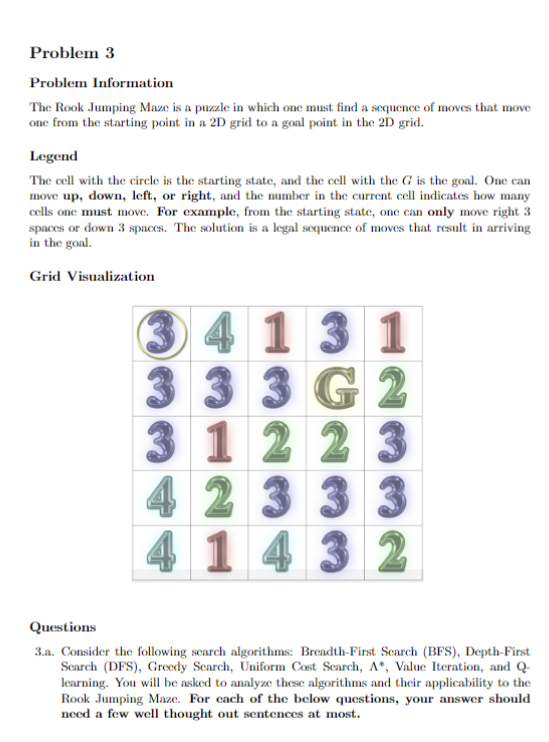
ai pt Is BreadthFirst Search BFS an appropriate algorithm to use for finding the optimal solution path in the Rook Jumping Maze YesNo Why or why not?
YOUR ANSWER.
aii pt Is DepthFirst Search DFS an appropriate algorithm to use for finding the optimal solution path in the Rook Jumping Maze YesNo Why or why not?
YOUR ANSWER.
aiii pt Is Greedy Search an appropriate algorithm to use for finding the optimal solution path in the Rook Jumping Maze YesNo Why or why not? YOUR ANSWER.
aiv pt Is Lambda Search an appropriate algorithm to use for finding the optimal solution path in the Rook Jumping Maze YesNo Why or why not? If you answered "Yes" describe how the heuristic works in your justification. YOUR ANSWER.
av pt Is Value Iteration an appropriate algorithm to use for finding the optimal solution path in the Rook Jumping Maze YesNo Why or why not? If you answered "Yes", describe how the reward and transition functions work in words. YOUR ANSWER.
avi pt Is Qlearning an appropriate algorithm to use for finding the optimal solution path in the Rook Jumping Maze YesNo Why or why not? If you answered "Yes", describe how the reward and transition functions work in words. YOUR ANSWER.
avii pt Considering all of the above algorithms, which is the most appropriate to best find the optimal solution path? Hint: Consider completeness, finding the optimal solution path, efficiency, etc.
YOUR ANSWER.
b pts Compute the average branching factor ie the average number of successors for the maze in the image above. You may express your answer as a fraction or a decimal.
YOUR ANSWER
c pts Suppose you wanted to use BreadthFirst Search BFS DepthFirst Search DFS Uniform Cost Search UCS or Lambda but you wanted to run the search from the goal to the initial state. That is: the cell labeled G is the initial state, and the cell with the circle is the goal state. To do this, you will need a predecessor function instead of a successor function. Describe in words how this predecessor function would work.
YOUR ANSWER
d pts Compute the average branching factor ie the average number of predecessors for the maze in the image above using your predecessor function. You may express your answer as a fraction or a decimal. e pts Given the choice between running the search forward from initial state to goal, or backward from goal to initial state, which would you choose, and why?
YOUR ANSWER
Step by Step Solution
There are 3 Steps involved in it
1 Expert Approved Answer
Step: 1 Unlock

Question Has Been Solved by an Expert!
Get step-by-step solutions from verified subject matter experts
Step: 2 Unlock
Step: 3 Unlock
 Study Help