







Question: 3. A manufacturer determines that the demand function for the parts is p=x1000 where x is the demand for the products at a given price,
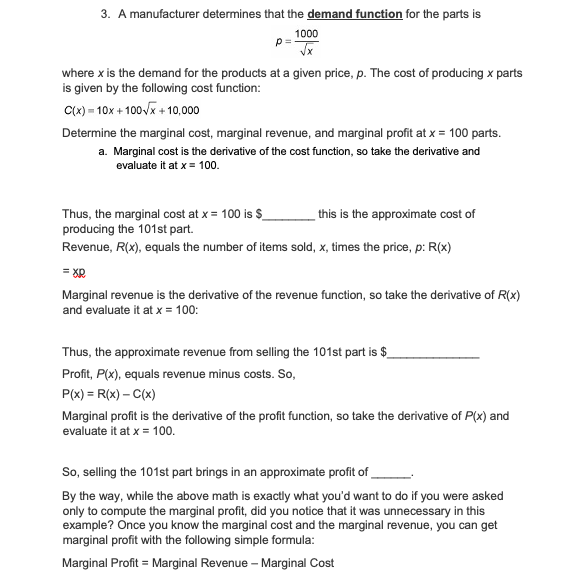
3. A manufacturer determines that the demand function for the parts is p=x1000 where x is the demand for the products at a given price, p. The cost of producing x parts is given by the following cost function: C(x)=10x+100x+10,000 Determine the marginal cost, marginal revenue, and marginal profit at x=100 parts. a. Marginal cost is the derivative of the cost function, so take the derivative and evaluate it at x=100. Thus, the marginal cost at x=100 is $ this is the approximate cost of producing the 101st part. Revenue, R(x), equals the number of items sold, x, times the price, p:R(x) =xR Marginal revenue is the derivative of the revenue function, so take the derivative of R(x) and evaluate it at x=100 : Thus, the approximate revenue from selling the 101st part is $ Profit, P(x), equals revenue minus costs. So, P(x)=R(x)C(x) Marginal profit is the derivative of the profit function, so take the derivative of P(x) and evaluate it at x=100. So, selling the 101st part brings in an approximate profit of By the way, while the above math is exactly what you'd want to do if you were asked only to compute the marginal profit, did you notice that it was unnecessary in this example? Once you know the marginal cost and the marginal revenue, you can get marginal profit with the following simple formula: Marginal Profit = Marginal Revenue - Marginal Cost
Step by Step Solution
There are 3 Steps involved in it

Get step-by-step solutions from verified subject matter experts
 Study Help