







Question: .3) A Pentium 4 processor, released in 2004, had a clock rate of 3.6GHz and voltage of 1.25V. Assume that, on average, it consumed 10W
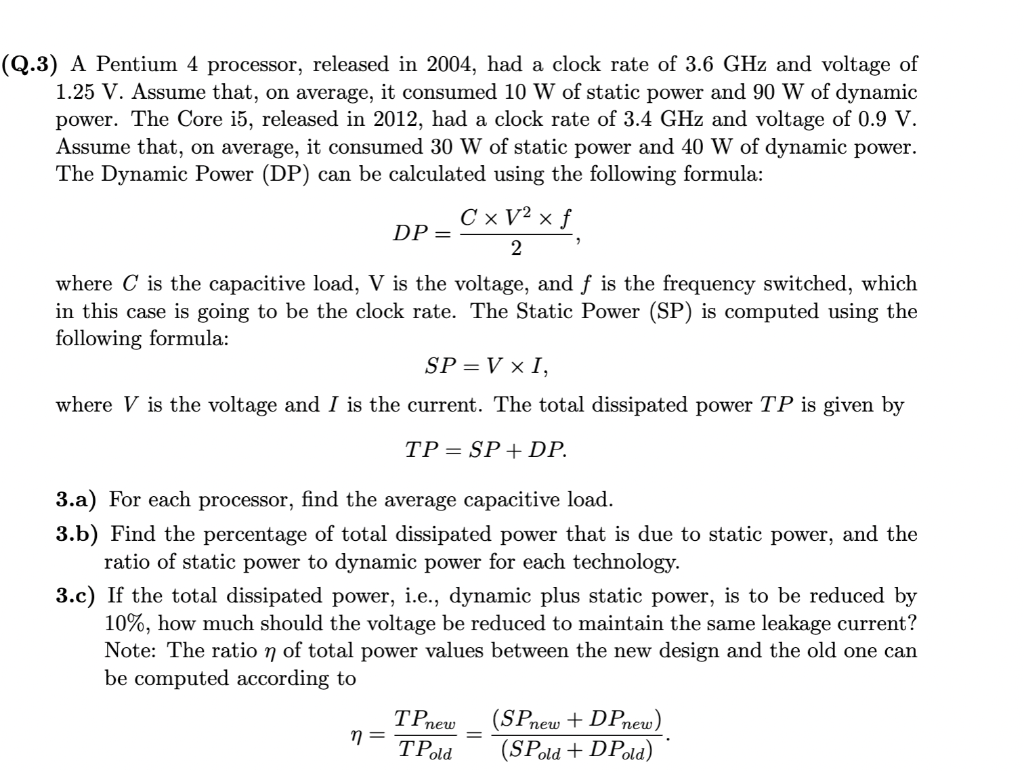
.3) A Pentium 4 processor, released in 2004, had a clock rate of 3.6GHz and voltage of 1.25V. Assume that, on average, it consumed 10W of static power and 90W of dynamic power. The Core i5, released in 2012, had a clock rate of 3.4GHz and voltage of 0.9V. Assume that, on average, it consumed 30W of static power and 40W of dynamic power. The Dynamic Power (DP) can be calculated using the following formula: DP=2CV2f, where C is the capacitive load, V is the voltage, and f is the frequency switched, which in this case is going to be the clock rate. The Static Power (SP) is computed using the following formula: SP=VI, where V is the voltage and I is the current. The total dissipated power TP is given by TP=SP+DP. 3.a) For each processor, find the average capacitive load. 3.b) Find the percentage of total dissipated power that is due to static power, and the ratio of static power to dynamic power for each technology. 3.c) If the total dissipated power, i.e., dynamic plus static power, is to be reduced by 10%, how much should the voltage be reduced to maintain the same leakage current? Note: The ratio of total power values between the new design and the old one can be computed according to =TPoldTPnew=(SPold+DPold)(SPnew+DPnew)
Step by Step Solution
There are 3 Steps involved in it

Get step-by-step solutions from verified subject matter experts
 Study Help