







Question: 3. A root of a function is a point where the function crosses the r-axis: f(r) = 0. Roots are so useful that is
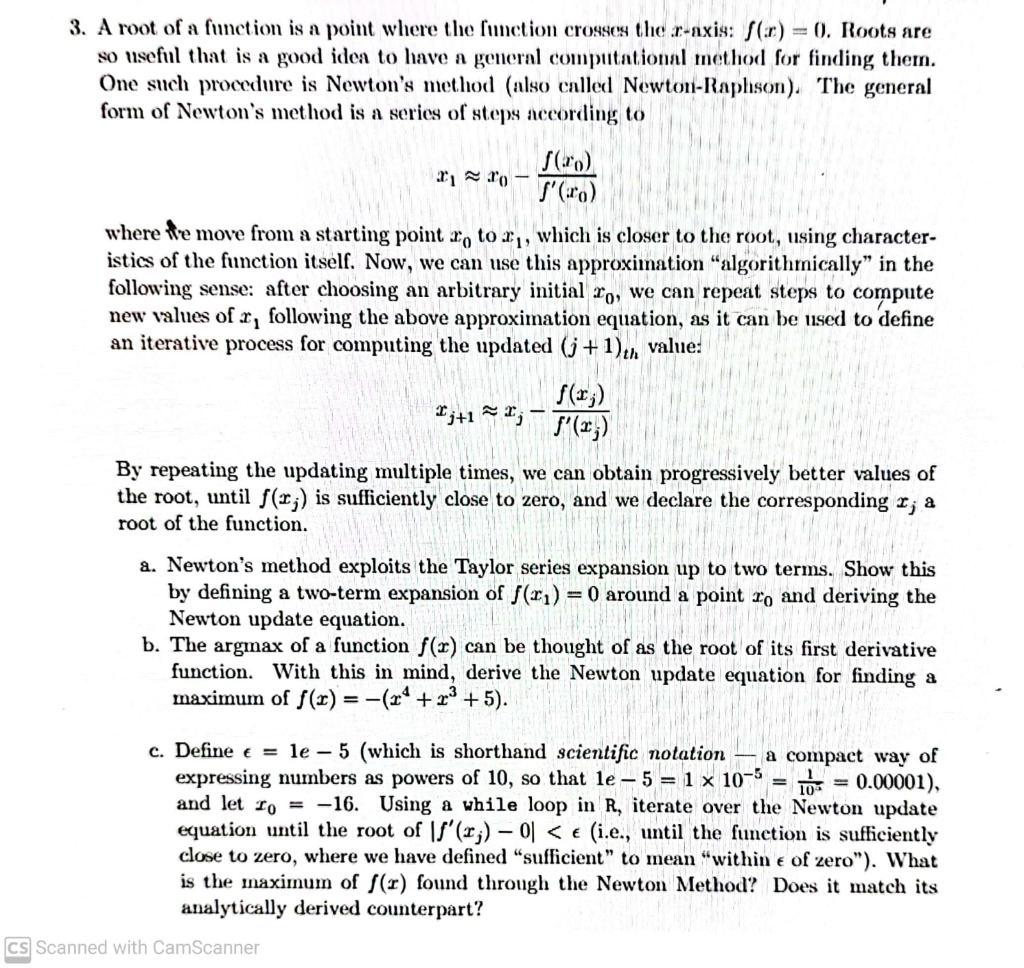
3. A root of a function is a point where the function crosses the r-axis: f(r) = 0. Roots are so useful that is a good idea to have a general computational method for finding them. One such procedure is Newton's method (also called Newton-Raphson). The general form of Newton's method is a series of steps according to 1 To f(ro) f'(o) where we move from a starting point ro to , which is closer to the root, using character- istics of the function itself. Now, we can use this approximation "algorithmically" in the following sense: after choosing an arbitrary initial ro, we can repeat steps to compute new values of r, following the above approximation equation, as it can be used to define an iterative process for computing the updated (j+1)th value: f(x) f'(x) Fj+1=;- By repeating the updating multiple times, we can obtain progressively better values of the root, until f(r,) is sufficiently close to zero, and we declare the corresponding r, a root of the function. a. Newton's method exploits the Taylor series expansion up to two terms. Show this by defining a two-term expansion of f() = 0 around a point ro and deriving the Newton update equation. b. The argmax of a function f(r) can be thought of as the root of its first derivative function. With this in mind, derive the Newton update equation for finding a maximum of f(x) = -(x+2+5). 10 a compact way of 0.00001), c. Define e le - 5 (which is shorthand scientific notation expressing numbers as powers of 10, so that le- 5 = 1 x 10-5 = 10 and let ro= -16. Using a while loop in R, iterate over the Newton update equation until the root of f'(r) - 0 < (i.e., until the function is sufficiently close to zero, where we have defined "sufficient" to mean "within e of zero"). What is the maximum of f(r) found through the Newton Method? Does it match its analytically derived counterpart? CS Scanned with CamScanner
Step by Step Solution
3.45 Rating (164 Votes )
There are 3 Steps involved in it
a To show that Newtons method exploits the Taylor series ex... View full answer

Get step-by-step solutions from verified subject matter experts
 Study Help