







Question: 3. A second order elementary gas phase reaction (A+BC,rA=kCACB) is carried out in an adiabatic constant pressure batch reactor. Reactor initially contains 30% by volume
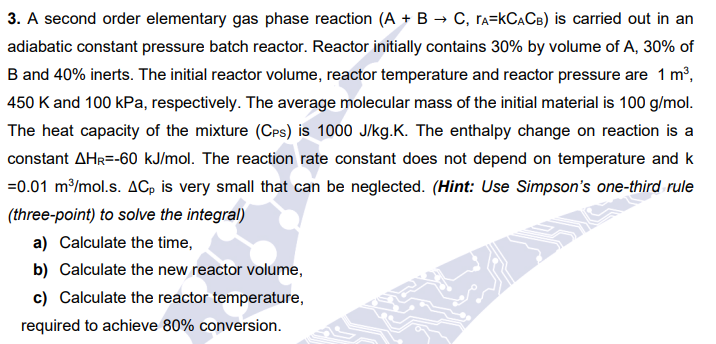
3. A second order elementary gas phase reaction (A+BC,rA=kCACB) is carried out in an adiabatic constant pressure batch reactor. Reactor initially contains 30% by volume of A,30% of B and 40% inerts. The initial reactor volume, reactor temperature and reactor pressure are 1m3, 450K and 100kPa, respectively. The average molecular mass of the initial material is 100g/mol. The heat capacity of the mixture (CPS) is 1000J/kg.K. The enthalpy change on reaction is a constant HR=60kJ/mol. The reaction rate constant does not depend on temperature and k =0.01m3/mol.s.Cp is very small that can be neglected. (Hint: Use Simpson's one-third rule (three-point) to solve the integral) a) Calculate the time, b) Calculate the new reactor volume, c) Calculate the reactor temperature, required to achieve 80% conversion. 3. A second order elementary gas phase reaction (A+BC,rA=kCACB) is carried out in an adiabatic constant pressure batch reactor. Reactor initially contains 30% by volume of A,30% of B and 40% inerts. The initial reactor volume, reactor temperature and reactor pressure are 1m3, 450K and 100kPa, respectively. The average molecular mass of the initial material is 100g/mol. The heat capacity of the mixture (CPS) is 1000J/kg.K. The enthalpy change on reaction is a constant HR=60kJ/mol. The reaction rate constant does not depend on temperature and k =0.01m3/mol.s.Cp is very small that can be neglected. (Hint: Use Simpson's one-third rule (three-point) to solve the integral) a) Calculate the time, b) Calculate the new reactor volume, c) Calculate the reactor temperature, required to achieve 80% conversion
Step by Step Solution
There are 3 Steps involved in it

Get step-by-step solutions from verified subject matter experts
 Study Help