



Question: 3. Answer the following questions using the Solow growth model. Population is growing at a rate of n and technological progress is occurring at a
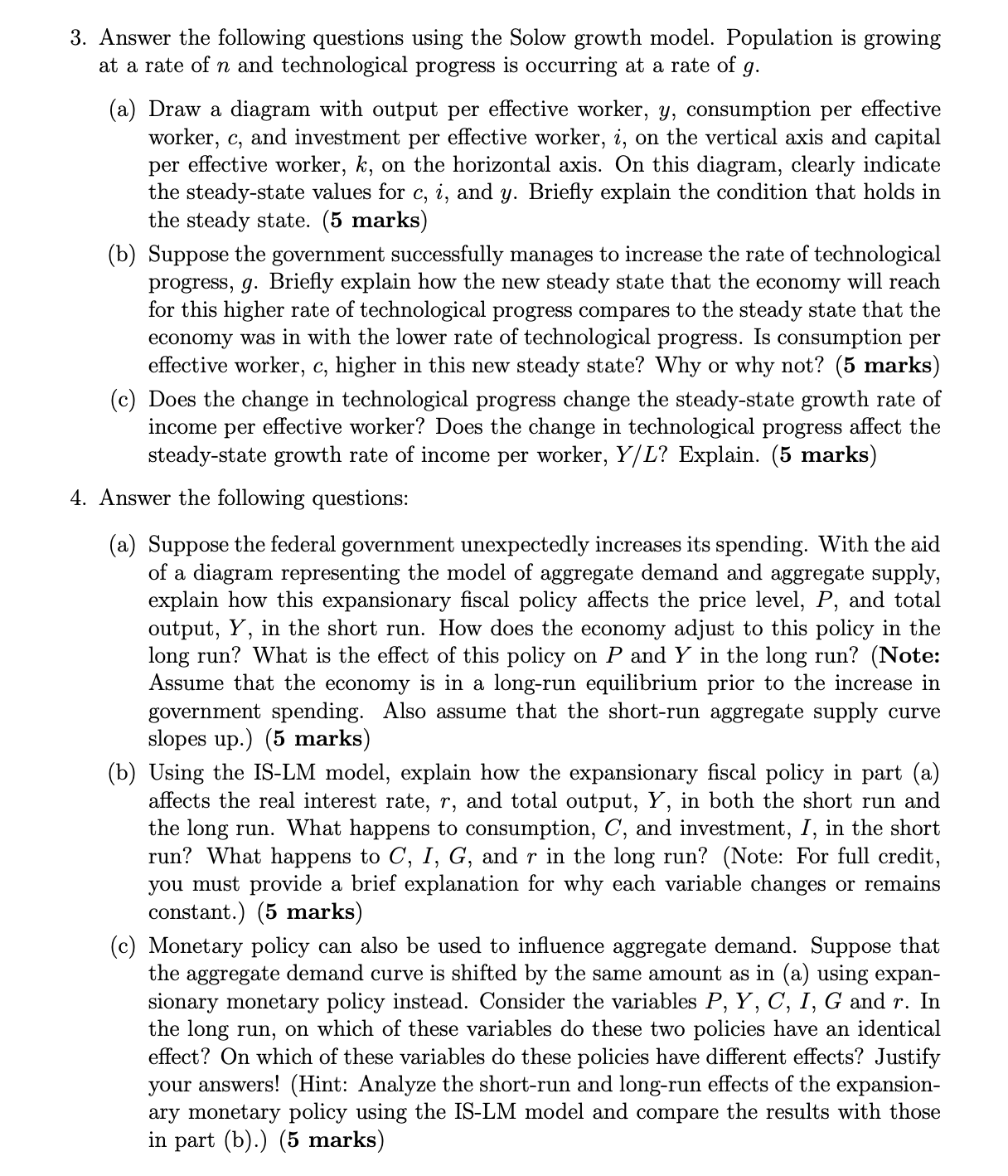
3. Answer the following questions using the Solow growth model. Population is growing at a rate of n and technological progress is occurring at a rate of g. (a) (C) Draw a diagram with output per effective worker, y, consumption per effective worker, c, and investment per effective worker, 2', on the vertical axis and capital per effective worker, 16, on the horizontal axis. On this diagram, clearly indicate the steady-state values for c, i, and y. Briey explain the condition that holds in the steady state. (5 marks) Suppose the government successfully manages to increase the rate of technological progress, 9. Briefly explain how the new steady state that the economy will reach for this higher rate of technological progress compares to the steady state that the economy was in with the lower rate of technological progress. ls consumption per effective worker, c, higher in this new steady state? Why or why not? (5 marks) Does the change in technological progress change the steady-state growth rate of income per effective worker? Does the change in technological progress affect the steady-state growth rate of income per worker, Y/ L? Explain. (5 marks) 4. Answer the following questions: (8) Suppose the federal government unexpectedly increases its spending. With the aid of a diagram representing the model of aggregate demand and aggregate supply, explain how this expansionary fiscal policy affects the price level, P, and total output, Y, in the short run. How does the economy adjust to this policy in the long run? What is the effect of this policy on P and Y in the long run? (Note: Assume that the economy is in a long-run equilibrium prior to the increase in government spending. Also assume that the short-run aggregate supply curve slopes up.) (5 marks) Using the IS-LM model, explain how the expansionary fiscal policy in part (a) affects the real interest rate, r, and total output, Y, in both the short run and the long run. What happens to consumption, 0, and investment, I, in the short run? What happens to C, I, G, and r in the long run? (Note: For full credit, you must provide a brief explanation for why each variable changes or remains constant.) (5 marks) Monetary policy can also be used to inuence aggregate demand. Suppose that the aggregate demand curve is shifted by the same amount as in (a) using expan sionary monetary policy instead. Consider the variables P, Y, C, I, G and r. In the long run, on which of these variables do these two policies have an identical effect? On which of these variables do these policies have different effects? Justify your answers! (Hint: Analyze the short-run and longrun effects of the expansion ary monetary policy using the lS-LM model and compare the results with those in part (b).)
Step by Step Solution
There are 3 Steps involved in it

Get step-by-step solutions from verified subject matter experts