







Question: 3 . Bottleneck Problem The process diagram for two products made by B/N Inc is given as follows: NOTE: Each arrow represents flow of 1
3. Bottleneck Problem
The process diagram for two products made by B/N Inc is given as follows:
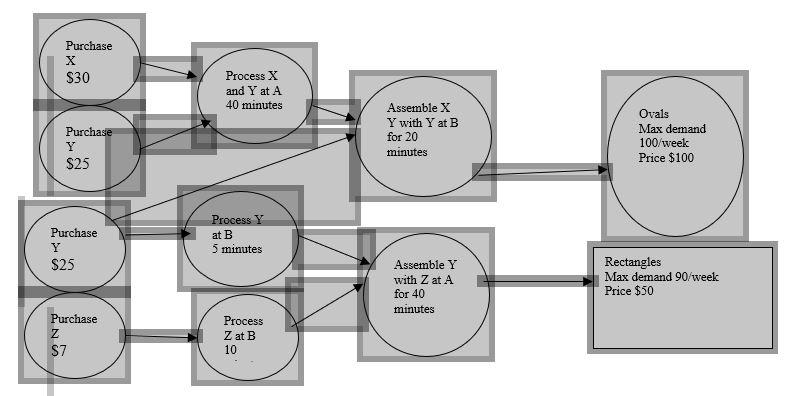
NOTE: Each arrow represents flow of 1 unit of the component/subassembly (so you need 1X and 2 Y to make an Oval and 1 Y and 1 Z to make a Rectangle). Sequencing of operations on resources is not considered. A and B are the only two resources operating 2400 minutes per week. ALL DATA IS GIVEN ON A PER UNIT BASIS I.E. $ PER UNIT AND MINUTES PER UNIT/ MAX DEMAND IS GIVEN IN UNITS PER WEEK.
- Which resource is the bottleneck?
Load of resource A is 7600 minutes; load of resource B is 3350 minutes.
Resource A is the bottleneck.
- Which product will you make more of and why?
Cont Margin of Ovals = 100 (1*30+2*25) = $20/unit
Cont Margin of Rectangles = 50 (1*25+1*7) = $18/unit
Cont Margin per minute of bottleneck station time of Ovals = 20/40 = $.50
Cont Margin per minute of bottleneck station time of Rectangles = 18/40 = $.45
We will make more Ovals as the contribution margin per minute of bottleneck station for Ovals is higher.
- How many Ovals and Rectangles should be sold every week?
Quantity of ovals able to be produced in 2400 min/week = 60 units
Leaving no remaining time after production of 60 ovals on resource A, so no rectangles can be produced.
Number of Ovals sold every week = 60
Number of Rectangles sold every week = 0
- What is the contribution margin derived from this strategy (your strategy in part c)?
Contribution margin = 60*20+0*18 = $1200
- If the capacity of the bottleneck is doubled (that is from 2400 to 4800 minutes), how does your strategy in part (b) change? How does the answer to part (c) and (d) change? Derive a general principle for capacity planning from your observations above.
Please answer part e, thank you!
Purchase X $30 Process X and Y at A 40 minutes Purchase Y $25 Assemble X Y with Y at B for 20 minutes Ovals Max demand 100/week Price $100 Purchase Y $25 Process Y at B 5 minutes Assemble Y with Zat A for 40 minutes Rectangles Max demand 90/week Price $50 Purchase Z $7 Process Zat B 10Step by Step Solution
There are 3 Steps involved in it

Get step-by-step solutions from verified subject matter experts
 Study Help