







Question: 3 Classification Methods (a) With AdaBoost, we combine many weak learners to output final classification result. For those weak learners, we mentioned that a very
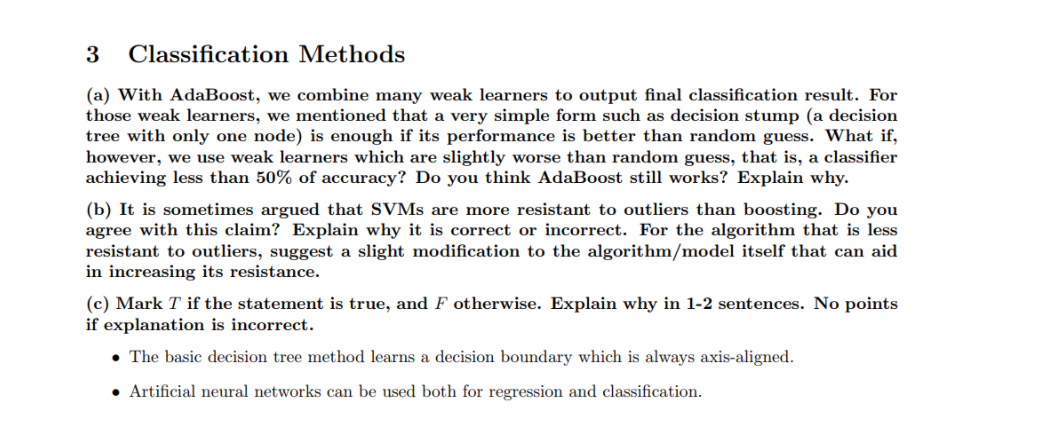
3 Classification Methods (a) With AdaBoost, we combine many weak learners to output final classification result. For those weak learners, we mentioned that a very simple form such as decision stump (a decision tree with only one node) is enough if its performance is better than random guess. What if, however, we use weak learners which are slightly worse than random guess, that is, a classifier achieving less than 50% of accuracy? Do you think AdaBoost still works? Explain why. (b) It is sometimes argued that SVMs are more resistant to outliers than boosting. Do you agree with this claim? Explain why it is correct or incorrect. For the algorithm that is less resistant to outliers, suggest a slight modification to the algorithm/model itself that can aid n increasing its resistance. (c) Mark T if the statement is true, and F otherwise. Explain why in 1-2 sentences. No points if explanation is incorrect. The basic decision tree method learns a decision boundary which is always axis-aligned. Artificial neural networks can be used both for regression and classification. 3 Classification Methods (a) With AdaBoost, we combine many weak learners to output final classification result. For those weak learners, we mentioned that a very simple form such as decision stump (a decision tree with only one node) is enough if its performance is better than random guess. What if, however, we use weak learners which are slightly worse than random guess, that is, a classifier achieving less than 50% of accuracy? Do you think AdaBoost still works? Explain why. (b) It is sometimes argued that SVMs are more resistant to outliers than boosting. Do you agree with this claim? Explain why it is correct or incorrect. For the algorithm that is less resistant to outliers, suggest a slight modification to the algorithm/model itself that can aid n increasing its resistance. (c) Mark T if the statement is true, and F otherwise. Explain why in 1-2 sentences. No points if explanation is incorrect. The basic decision tree method learns a decision boundary which is always axis-aligned. Artificial neural networks can be used both for regression and classification
Step by Step Solution
There are 3 Steps involved in it

Get step-by-step solutions from verified subject matter experts
 Study Help