







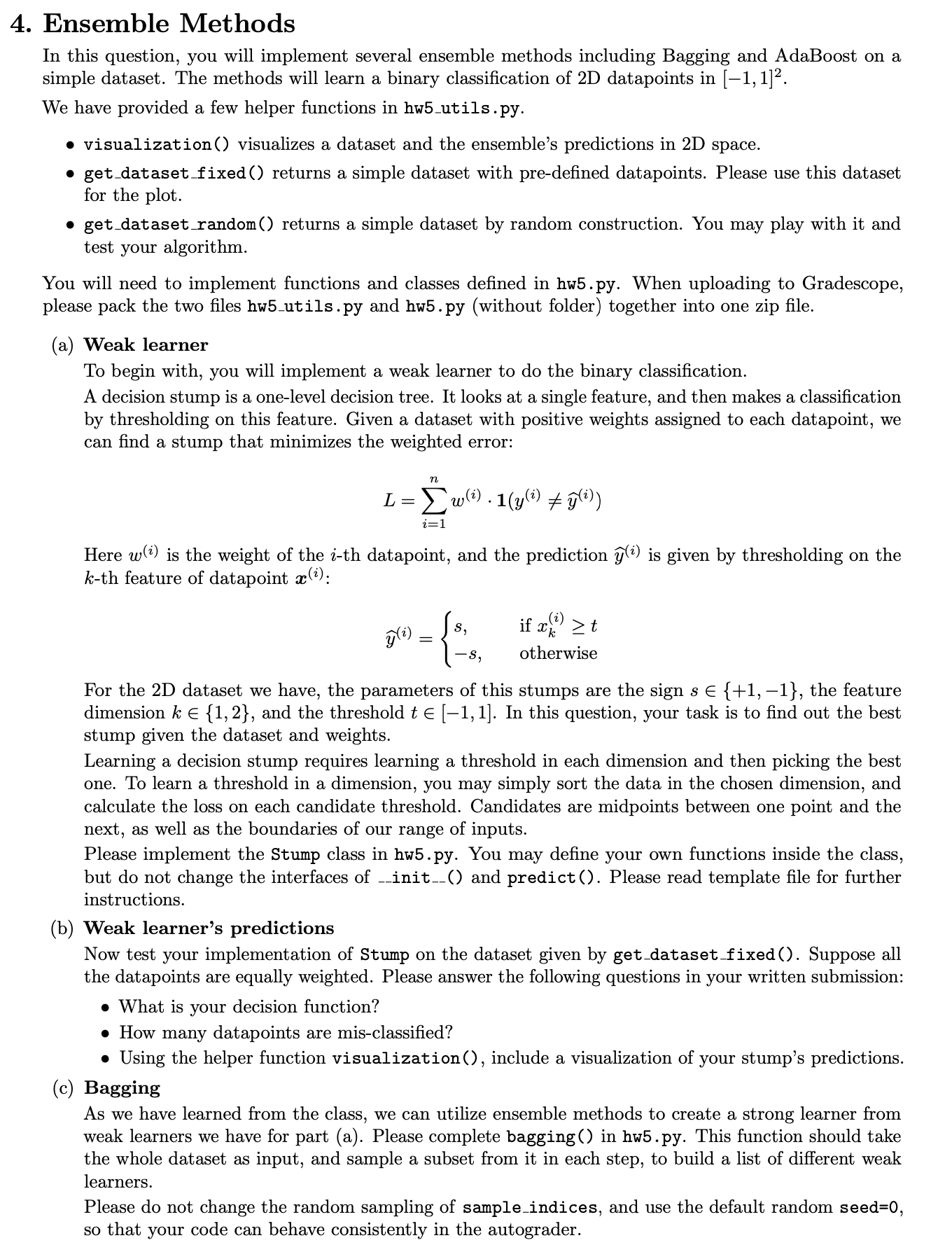
Question: 4 . Ensemble Methods In this question, you will implement several ensemble methods including Bagging and AdaBoost on a simple dataset. The methods will learn
Ensemble Methods
In this question, you will implement several ensemble methods including Bagging and AdaBoost on a simple dataset. The methods will learn a binary classification of D datapoints in
a Weak learner
To begin with, you will implement a weak learner to do the binary classification.
A decision stump is a onelevel decision tree. It looks at a single feature, and then makes a classification by thresholding on this feature. Given a dataset with positive weights assigned to each datapoint, we can find a stump that minimizes the weighted error:
Lsumin wicdot mathbfleftyi
eq widehatyiright
Here wi is the weight of the i th datapoint, and the prediction widehatyi is given by thresholding on the k th feature of datapoint boldsymbolxi :
widehatyileftbeginarrayll
s & text if xkigeq t
s & text otherwise
endarrayright
For the D dataset we have, the parameters of this stumps are the sign s in the feature dimension k in and the threshold t in In this question, your task is to find out the best stump given the dataset and weights.
Learning a decision stump requires learning a threshold in each dimension and then picking the best one. To learn a threshold in a dimension, you may simply sort the data in the chosen dimension, and calculate the loss on each candidate threshold. Candidates are midpoints between one point and the next, as well as the boundaries of our range of inputs.
Please implement the Stump class in hwpy You may define your own functions inside the class, but do not change the interfaces of init and predict Please read template file for further instructions.
b Weak learner's predictions
Now test your implementation of Stump on the dataset given by getdatasetfixed Suppose all the datapoints are equally weighted. Please answer the following questions in your written submission:
What is your decision function?
How many datapoints are misclassified?
Using the helper function visualization include a visualization of your stump's predictions.
c Bagging
As we have learned from the class, we can utilize ensemble methods to create a strong learner from weak learners we have for part a Please complete bagging in hwpy This function should take the whole dataset as input, and sample a subset from it in each step, to build a list of different weak learners.
Please do not change the random sampling of sampleindices, and use the default random seed so that your code can behave consistently in the autograder.
class Stump:
# gettingdata and changing their type from tuple to array
def initself data, labels, weightsNone:
Initializes a stump onelevel decision tree which minimizes
a weighted error function of the input dataset.
In this function, you will need to learn a stump using the weighted
datapoints. Each datapoint has features, whose values are bounded in
Each datapoint has a label in and its importance
is weightedby a positive value.
The stump will choose one of the features, and pick the best threshold
in that dimension, so that the weighted error is minimized.
Arguments:
data: An ndarray with shape n Values in
labels: An ndarray with shape n Values are or
weights: An ndarray with shape n The weights of each
datapoint, all positive.
# You may choose to use the following variables as a start
# The feature dimension which the stump will decide on
# Either or since the datapoints are D
self.dimension
# The threshold in that dimension
# May be midpoints between datapoints or the boundaries
self.threshold
# The predicted sign when the datapoint's feature in that dimension
# is greater than the threshold
# Either or
self.sign
pass
def predictself data:
Arguments:
data: An ndarray with shape n Values in
Returns:
prediction: An ndarray with shape n Values are or
pass
def baggingdata labels, nclassifiers, nsamples, seed:
Arguments:
data: An ndarray with shape n Values in
labels: An ndarray with shape n Values are or
nclassifiers: Number of classifiers to construct.
nsamples: Number of samples to train each classifier.
seed: Random seed for NumPy.
Returns:
classifiers: A list of classifiers.
classifiers
n data.shape
for i in rangenclassifiers:
nprandom.seedseed i
sampleindices nprandom.choicen sizensamples, replaceFalse
# complete the rest of the loop
pass
def adaboostdata labels, nclassifiers:
Arguments:
data: An ndarray with shape n Values in
labels: An ndarray with shape n Values are or
nclassifiers: Number of classifiers to construct.
Returns:
classifiers: A list of classifiers.
weights: A list of
Step by Step Solution
There are 3 Steps involved in it
1 Expert Approved Answer
Step: 1 Unlock

Question Has Been Solved by an Expert!
Get step-by-step solutions from verified subject matter experts
Step: 2 Unlock
Step: 3 Unlock
 Study Help