







Question: 3. Consider a 1-D ideal sampling function defined as + 06 Sideal (X, Ax) = > 5(x - n . Ax) (6(x - n .
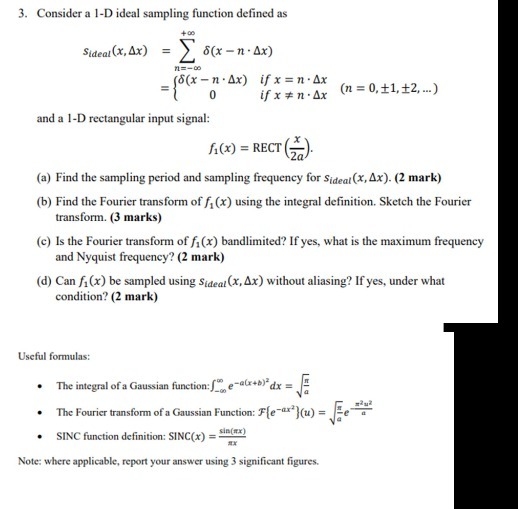
3. Consider a 1-D ideal sampling function defined as + 06 Sideal (X, Ax) = > 5(x - n . Ax) (6(x - n . Ax) if x = n . Ax 0 if x # n . Ax (n = 0,+1, +2, ...) and a 1-D rectangular input signal: (x) = RECT (a) Find the sampling period and sampling frequency for Sideal (x, Ax). (2 mark) (b) Find the Fourier transform of f, (x) using the integral definition. Sketch the Fourier transform. (3 marks) (c) Is the Fourier transform of f, (x) bandlimited? If yes, what is the maximum frequency and Nyquist frequency? (2 mark) (d) Can fi (x) be sampled using Sideat (x, Ax) without aliasing? If yes, under what condition? (2 mark) Useful formulas: The integral of a Gaussian function: " e-atr+6) dx =: The Fourier transform of a Gaussian Function: Fe or](u) = fe SINC function definition: SINC(x) = sin(ax) Note: where applicable, report your answer using 3 significant figures
Step by Step Solution
There are 3 Steps involved in it

Get step-by-step solutions from verified subject matter experts
 Study Help