







Question: 3. Consider a 1-D ideal sampling function defined as +oo Sideal(x, Ax) = 5(x-n.Ax) 112=-00 = {(x-n. 0 and a 1-D rectangular input signal:
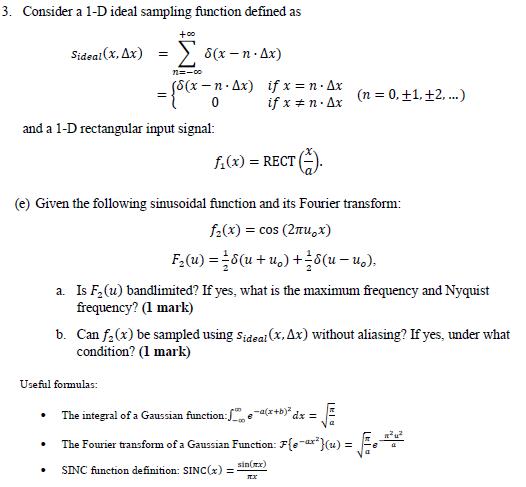
3. Consider a 1-D ideal sampling function defined as +oo Sideal(x, Ax) = 5(x-n.Ax) 112=-00 = {(x-n. 0 and a 1-D rectangular input signal: 2.Ax) if x = n. Ax if x #n. Ax f(x) = RECT(). (e) Given the following sinusoidal function and its Fourier transform: f(x) = cos (2nux) F(u) = 8(u+u) + d(u-uo), a. Is F (u) bandlimited? If yes, what is the maximum frequency and Nyquist frequency? (1 mark) Useful formulas: . b. Can f (x) be sampled using Sideal (x, Ax) without aliasing? If yes, under what condition? (1 mark) The integral of a Gaussian function:fa(x+b) dx = The Fourier transform of a Gaussian Function: F{e-ux}(u): SINC function definition: SINC(x) = sin(xx) XX (n = 0, +1, +2, ...) = nu
Step by Step Solution
3.47 Rating (157 Votes )
There are 3 Steps involved in it
a Yes F2u is bandlimited The maximum frequency is ... View full answer

Get step-by-step solutions from verified subject matter experts
 Study Help