







Question: 3. Consider the following encryption scheme, parametrized by a number n > 0. The message space is M-0,1,cosisting of all bit strings of length n.
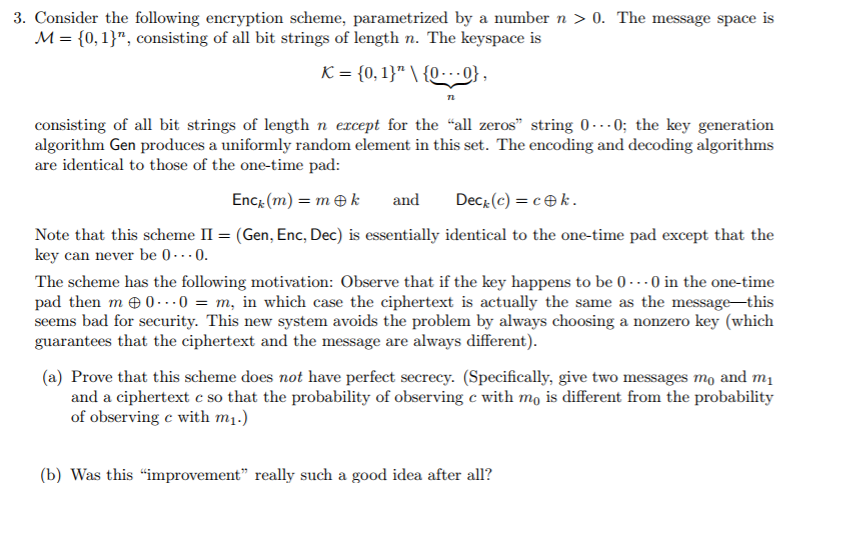
3. Consider the following encryption scheme, parametrized by a number n > 0. The message space is M-0,1,cosisting of all bit strings of length n. The keyspace is consisting of all bit strings of length n ercept for the "all zeros" string 00; the key generation algorithm Gen produces a uniformly random element in this set. The encoding and decoding algorithms are identical to those of the one-time pad Enck(m) = mk and Deck(c) = ck. Note that this scheme (Gen, Enc, Dec) is essentially identical to the one-time pad except that the key can never be 00. The scheme has the following motivation: Observe that if the key happens to be 00 in the one-time pad then ma0 0 = m, in which case the ciphertext is actually the same as the message-this seems bad for security. This new system avoids the problem by always choosing a nonzero key (which guarantees that the ciphertext and the message are always different) (a) Prove that this scheme does not have perfect secrecy. (Specifically, give two messages mo and mi and a ciphertext c so that the probability of observing c with mo is different from the probability of observing c with mi.) (b) Was this "improvement" really such a good idea after all
Step by Step Solution
There are 3 Steps involved in it

Get step-by-step solutions from verified subject matter experts
 Study Help