Question: 3. Consider the following problem known as Boolean least squares: = min A: - 3: (-1,1), 1 = 1...... Here the variable is r ER,
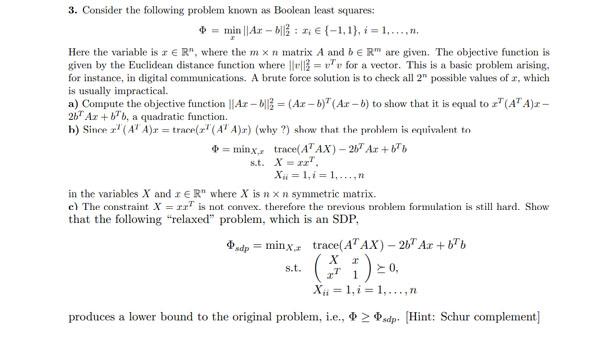
3. Consider the following problem known as Boolean least squares: = min A: - 3: (-1,1), 1 = 1...... Here the variable is r ER", where the mx n matrix A and b ER" are given. The objective function is given by the Euclidean distance function where 43 = vv for a vector. This is a basic problem arising, for instance, in digital communications. A brute force solution is to check all 2" possible values of , which is usually impractical. a) Compute the objective function ||42 413 = (Ar )" (Ar b) to show that it is equal to 2" (AA): - 26" Az +"), a quadratic function. b) Since (AA).x = trace(x:"(APA),r) (why?) show that the problem is eqnivalent to $ = minx trace(AT AX) - 20" Ax+ s.t. X = x Xi = 1, 1 = 1,..., in the variables X and XER" where X is n x n symmetric matrix. c) The constraint X = n/" is not convex, therefore the previous problem formulation is still hardi. Show that the following "relaxed" problem, which is an SDP, sdp = minx. trace(AT AX) - 207 Ar +678 >0. X = 1, i = 1,..., produces a lower bound to the original problem, i.e., > bsdp (Hint: Schur complement] s.t. 1) 3. Consider the following problem known as Boolean least squares: = min A: - 3: (-1,1), 1 = 1...... Here the variable is r ER", where the mx n matrix A and b ER" are given. The objective function is given by the Euclidean distance function where 43 = vv for a vector. This is a basic problem arising, for instance, in digital communications. A brute force solution is to check all 2" possible values of , which is usually impractical. a) Compute the objective function ||42 413 = (Ar )" (Ar b) to show that it is equal to 2" (AA): - 26" Az +"), a quadratic function. b) Since (AA).x = trace(x:"(APA),r) (why?) show that the problem is eqnivalent to $ = minx trace(AT AX) - 20" Ax+ s.t. X = x Xi = 1, 1 = 1,..., in the variables X and XER" where X is n x n symmetric matrix. c) The constraint X = n/" is not convex, therefore the previous problem formulation is still hardi. Show that the following "relaxed" problem, which is an SDP, sdp = minx. trace(AT AX) - 207 Ar +678 >0. X = 1, i = 1,..., produces a lower bound to the original problem, i.e., > bsdp (Hint: Schur complement] s.t. 1)









 Study Help