







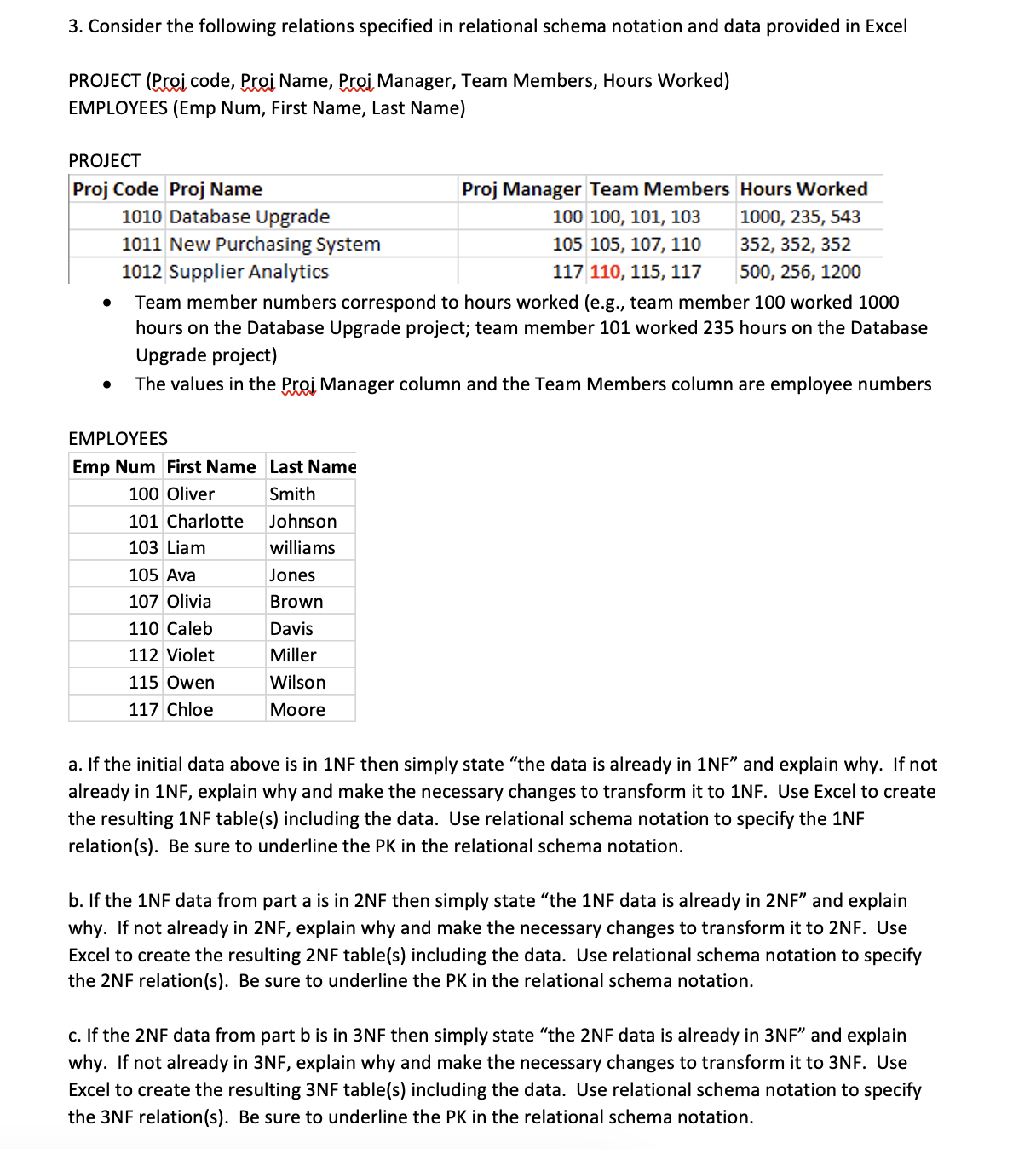
Question: 3 . Consider the following relations specified in relational schema notation and data provided in Excel PROJECT ( Proj code, Proj Name, Proj Manager, Team
Consider the following relations specified in relational schema notation and data provided in Excel
PROJECT Proj code, Proj Name, Proj Manager, Team Members, Hours Worked
EMPLOYEES Emp Num, First Name, Last Name
Team member numbers correspond to hours worked eg team member worked hours on the Database Upgrade project; team member worked hours on the Database Upgrade project
The values in the Proj Manager column and the Team Members column are employee numbers
a If the initial data above is in NF then simply state "the data is already in NF and explain why. If not already in NF explain why and make the necessary changes to transform it to NF Use Excel to create the resulting NF tables including the data. Use relational schema notation to specify the NF relations Be sure to underline the PK in the relational schema notation.
b If the NF data from part a is in NF then simply state "the NF data is already in NF and explain why. If not already in NF explain why and make the necessary changes to transform it to NF Use Excel to create the resulting NF tables including the data. Use relational schema notation to specify the NF relations Be sure to underline the PK in the relational schema notation.
c If the NF data from part b is in NF then simply state "the NF data is already in NF and explain why. If not already in NF explain why and make the necessary changes to transform it to NF Use Excel to create the resulting NF tables including the data. Use relational schema notation to specify the NF relations Be sure to underline the PK in the relational schema notation.
Step by Step Solution
There are 3 Steps involved in it
1 Expert Approved Answer
Step: 1 Unlock

Question Has Been Solved by an Expert!
Get step-by-step solutions from verified subject matter experts
Step: 2 Unlock
Step: 3 Unlock
 Study Help