







Question: 3 Cooperation problem and coordination problem Consider Table 1, a payoff matrix for Player A and Player B. a. Under what condition will Option 1
3 Cooperation problem and coordination problem
Consider Table 1, a payoff matrix for Player A and Player B.
a. Under what condition will Option 1 be a dominant strategy for Player A?
b. Under what condition will Option 1 be a dominant strategy for Player B?
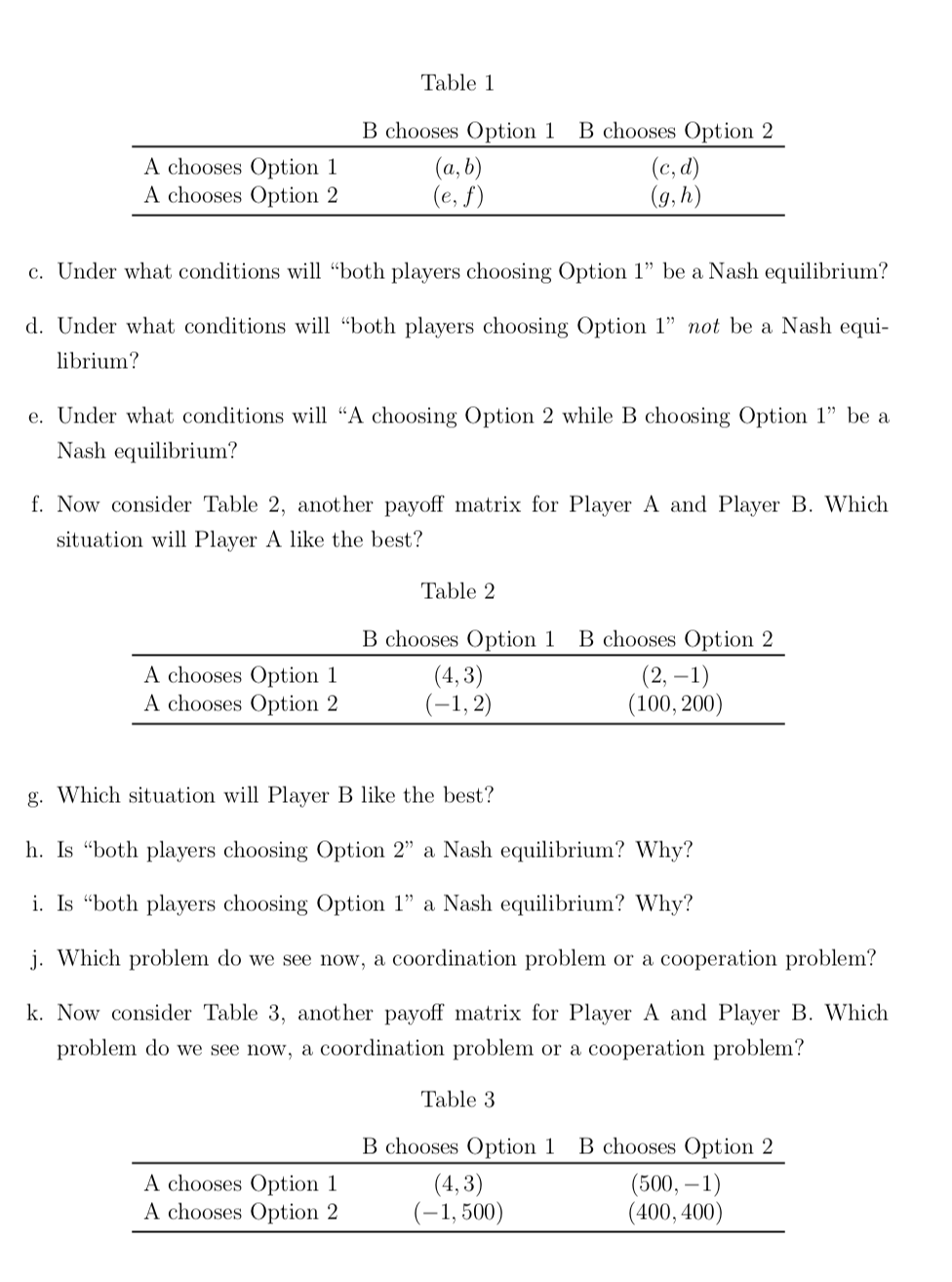
Table 1 B chooses Option 1 B chooses Option 2 A chooses Option 1 (a, b) (c,d) A chooses Option 2 (e, f) (g,h) . Under what conditions will \"both players choosing Option 1\" be a Nash equilibrium? . Under what conditions will \"both players choosing Option 1\" not be a Nash equi- librium? . Under what conditions will \"A choosing Option 2 while B choosing Option 1\" be a Nash equilibrium? . Now consider Table 2, another payoff matrix for Player A and Player B. Which situation will Player A like the best? Table 2 B chooses Option 1 B chooses Option 2 A chooses Option 1 (4, 3) (2, l) A chooses Option 2 (1, 2) (100, 200) . Which situation will Player B like the best? . Is \"both players choosing Option 2\" a Nash equilibrium? Why? '. Is \"both players choosing Option 1\" a Nash equilibrium? Why? '. Which problem do we see now, a coordination problem or a cooperation problem? . Now consider Table 3, another payoff matrix for Player A and Player B. Which problem do we see now, a coordination problem or a cooperation problem? Table 3 B chooses Option 1 B chooses Option 2 A chooses Option 1 (4, 3) (500, l) A chooses Option 2 (-1, 500) (400, 400)
Step by Step Solution
There are 3 Steps involved in it

Get step-by-step solutions from verified subject matter experts
 Study Help