







Question: #3. Dunkin Donut Opening scenario for Chapter 7- Has Dunkin Donut use of marketing research kept it competitive in its market. Identify/explain at least one
#3. Dunkin Donut Opening scenario for Chapter 7- Has Dunkin Donut use of marketing research kept it competitive in its market. Identify/explain at least one type of qualitative research it uses and one type of quantitative research it uses.
Reply
PreviousNext
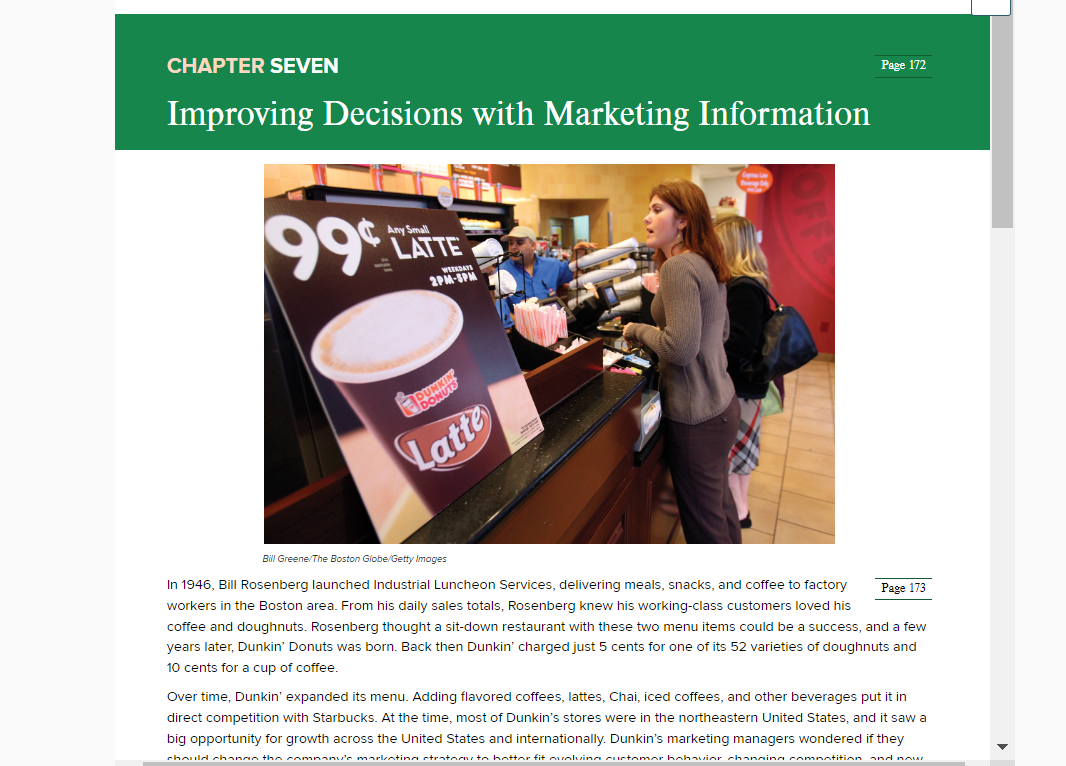
In 1946, Bill Rosenberg launched Industrial Luncheon Services, delivering meals, snacks, and coffee to factory workers in the Boston area. From his daily sales totals, Rosenberg knew his working-class customers loved his Page 173 coffee and doughnuts. Rosenberg thought a sit-down restaurant with these two menu items could be a success, and a few years later, Dunkin' Donuts was born. Back then Dunkin' charged just 5 cents for one of its 52 varieties of doughnuts and 10 cents for a cup of coffee. Over time, Dunkin' expanded its menu. Adding flavored coffees, lattes, Chai, iced coffees, and other beverages put it in direct competition with Starbucks. At the time, most of Dunkin's stores were in the northeastern United States, and it saw a big opportunity for growth across the United States and internationally. Dunkin's marketing managers wondered if they Over time, Dunkin' expanded its menu. Adding flavored coffees, lattes, Chai, iced coffees, and other beverages put it in direct competition with Starbucks. At the time, most of Dunkin's stores were in the northeastern United States, and it saw a big opportunity for growth across the United States and internationally. Dunkin's marketing managers wondered if they should change the company's marketing strategy to better fit evolving customer behavior, changing competition, and new target markets. Dunkin' managers knew they had many options: for example, adding new sandwiches, offering catering and delivery services, and providing cozier seating. They hired Copernicus Marketing to conduct research and help design Dunkin's "store of the future." Product design software evaluated more than 2 billion combinations by varying portion sizes, exterior store design, interior music selection, and more. With data from a nationally representative sample of more than 1,000 customers and prospects, sales and costs were forecast for each combination, and the most profitable options were identified. The decision support software suggested a marketing mix that emphasized Dunkin's quality coffee, speedy service at the counter, and drive-through windows would best deliver sales-and a new strategy was born. As Dunkin' Donuts grew, it sought to better understand its loyal coffee drinkers-and those of its chief rival, Starbucks. Dunkin' paid dozens of its most dedicated customers to buy coffee at Starbucks, while simultaneously paying a similar number of Starbucks loyalists to come to Dunkin' Donuts. After debriefing interviews, the two groups were found to be so different that Dunkin' researchers dubbed them "tribes." What each tribe detested about its rival's store was exactly what made it love its usual outlet. For example, Starbucks' regulars found Dunkin' outlets boring, austere, and unoriginal. They didn't like that workers dumped standard amounts of milk and sugar in their drinks; they didn't feel special at Dunkin' Donuts. Although Dunkin' tribe members wanted newerlooking stores, the Starbucks experience turned them off. All those laptop users made it hard to find a seat-and they wondered why coffee shops needed couches. They complained about Starbucks' higher prices and slower service. They didn't like Starbucks' "tall," "grande," and "venti" lingo; just give us "small," "medium," and "Iarge" please! This exercise convinced Dunkin' that there were customers out there who wanted an alternative to Starbucks-and Dunkin' could finetune a marketing strategy to provide it. A psychographic survey offered further insight into the attitudes, values, and interests of Dunkin' tribe members. They're busy, love routine, prefer no frills, and see themselves as down-to-earth folks. While one-third of Americans fit this profile, these people are more common in the Midwest and southern United States. So Dunkin' focused its new store openings in these areas. The research also guided the "America Runs on Dunkin'" advertising campaign featuring office and construction workers getting through their days with the chain's help. Before Dunkin' Donuts adds new items to its menu, it tests the ideas with customers. Dunkin' chefs used focus groups to test a new line of hearty snacks for drive-through customers looking for an on-the-go snack. They found these customers liked the smoothies and hot flatbreads, but the tiny stuffed pinwheels did not satisfy their hunger. When Dunkin' came back with larger-sized "bites" filled with pork and other ingredients, customers approved, and new items appeared on Dunkin's menus. Dunkin' encourages customer feedback and listens closely for ideas to fine-tune its marketing strategy. A group of its best customers serve on the Dunkin' Advisory Panel, where they regularly complete surveys and participate in online focus groups. The company also monitors its website and social media efforts, reading what Facebook fans and Twitter followers write and using analytical software to monitor Dunkin's buzz on the Internet. Data even drive the precise location of each Dunkin' shop; a software program analyzes demographics, competition, and traffic patterns at the neighborhood level. For one store, this program predicted sales would increase by moving the store just 100 yards-from one end of a strip mall to the other-and adding a drive-through lane. After the move, sales jumped more than 50 percent. When Dunkin' wondered if the costs and discounts of a loyalty program would be offset by higher sales and profits, it conducted an experiment. A group of customers' purchases were monitored before and after they joined a prototype Dunkin' Donuts loyalty program. Customers in the program spent 40 percent more. Decision made. Now millions use the DD Perks app, which also gives Dunkin' data on individual customers. It shouldn't be a surprise that research guides Dunkin's sustainability and corporate social responsibility (CSR) efforts. Recent CSR strategies were developed after reviews of internal reports, interviews with senior managers, and surveys of employees and customers. The research identified what mattered most to internal and external stakeholders and how Dunkin' could have a positive impact. High-priority topics focused Dunkin's efforts on sustainable and ethical sourcing, security of customer data, and packaging. It led to decisions to trade out polystyrene for eco-friendly double-wall paper cups and to collaborate to support coffee sustainability. Research was also needed when Dunkin' Donuts considered changing its name to Dunkin'. Marketing managers wanted to simplify branding, signal a focus on beverages, and broaden its appeal to Millennials. Dunkin' tested the new name in a few locations and monitored customer reactions. When Dunkin' finally took the plunge, research by YouGov suggested it might be working. YouGov regularly surveys consumers about 1,600 brands, asking if they have "heard something positive about a brand and talked about the brand with friends and family in the past two weeks." As Dunkin's new branding was launched, YouGov reported that Dunkin' posted the biggest increase in positive word-of-mouth among Millennials. Dunkin' now has more than 11,500 stores in 41 countries. To keep growing, Dunkin' knows it has to keep collecting, analyzing, and acting on data for its marketing strategy planning, implementation, and control. 1 LEARNING OBJECTIVES The Dunkin' case shows that successful marketing strategies require information about potential target markets and their likely responses to marketing mixes-as well as information about competitors and other market environment variables. Managers also need information for implementation and control. Without good information, managers are left to guess-and in today's fast-changing markets, that invites failure. In this chapter, we discuss how marketing managers get the information that they need
Step by Step Solution
There are 3 Steps involved in it

Get step-by-step solutions from verified subject matter experts
 Study Help