



Question: 3. For each of the five languages given below, show a state diagram of a DFA that recognizes the language. Use as few states as
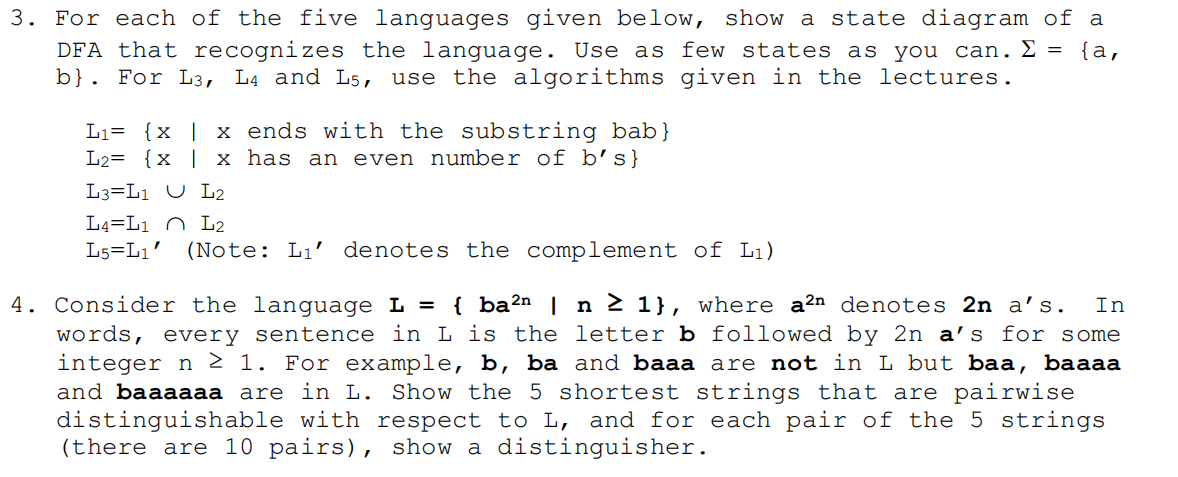
3. For each of the five languages given below, show a state diagram of a DFA that recognizes the language. Use as few states as you can. E = {a, b}. For L3, L4 and L5, use the algorithms given in the lectures. Li= { x x ends with the substring bab} L2= {x | x has an even number of b's} L3=Li U L2 L4=Li n L2 L5=Li' (Note: Li' denotes the complement of Li) In 4. Consider the language L = { ba2n | n ? 1}, where aan denotes 2n a's. words, every sentence in L is the letter b followed by 2n a's for some integer n ? 1. For example, b, ba and baaa are not in L but baa, baaaa and baaaaaa are in L. Show the 5 shortest strings that are pairwise distinguishable with respect to L, and for each pair of the 5 strings (there are 10 pairs), show a distinguisher. 3. For each of the five languages given below, show a state diagram of a DFA that recognizes the language. Use as few states as you can. E = {a, b}. For L3, L4 and L5, use the algorithms given in the lectures. Li= { x x ends with the substring bab} L2= {x | x has an even number of b's} L3=Li U L2 L4=Li n L2 L5=Li' (Note: Li' denotes the complement of Li) In 4. Consider the language L = { ba2n | n ? 1}, where aan denotes 2n a's. words, every sentence in L is the letter b followed by 2n a's for some integer n ? 1. For example, b, ba and baaa are not in L but baa, baaaa and baaaaaa are in L. Show the 5 shortest strings that are pairwise distinguishable with respect to L, and for each pair of the 5 strings (there are 10 pairs), show a distinguisher
Step by Step Solution
There are 3 Steps involved in it

Get step-by-step solutions from verified subject matter experts