







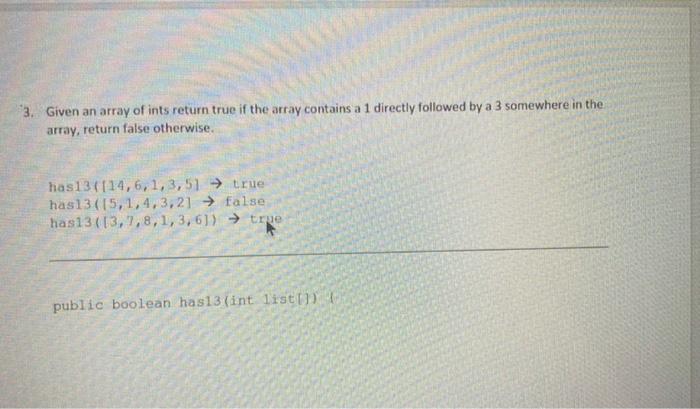
Question: 3. Given an array of ints return true if the array contains a 1 directly followed by a 3 somewhere in the array, return false
![return false otherwise. has13 (114,6,1,3,51 true has13.15, 1,4,3,21 false has13 (13,7,8,1,3,6]) true](https://dsd5zvtm8ll6.cloudfront.net/si.experts.images/questions/2024/09/66f527e95f596_56866f527e8f3301.jpg)
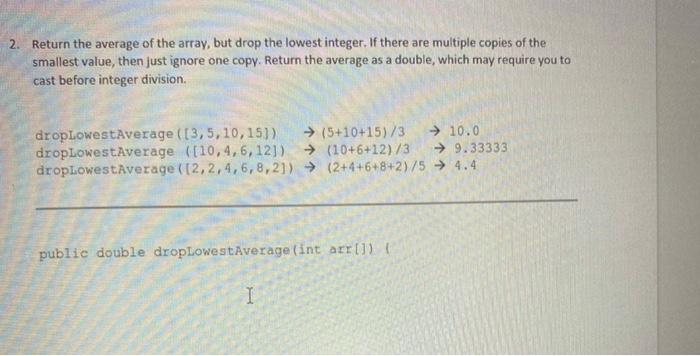
3. Given an array of ints return true if the array contains a 1 directly followed by a 3 somewhere in the array, return false otherwise. has13 (114,6,1,3,51 true has13.15, 1,4,3,21 false has13 (13,7,8,1,3,6]) true public boolean has13(int listu 2 Return the average of the array, but drop the lowest integer. If there are multiple copies of the smallest value, then just ignore one copy. Return the average as a double, which may require you to cast before integer division. droplowestAverage ([3,5,10,151) (5+10+15)/3 10.0 dropLowestAverage ([10,4,6,12]) (10+6+12)/3 9.33333 droplowestAverage (2,2,4,6,8,2]) (2+4+6+8+2)75 4.4 public double dropLowestAverage (int arr() I 1. Return the number of single-digit ints in the given array. countSingleDigs ([2,10,12,5,6,14]) 3 countSingleDigs ([12,14,15,10,90]) > 0 countSingleDigs ([2,3,4,5,6,10]) 5 public int countsingleDids (int[] nums)
Step by Step Solution
There are 3 Steps involved in it

Get step-by-step solutions from verified subject matter experts
 Study Help