







Question: 3. Given that S is a relation on the set B = (a, b, c, d, e, f, g. h, i) and 1111110007 1 1
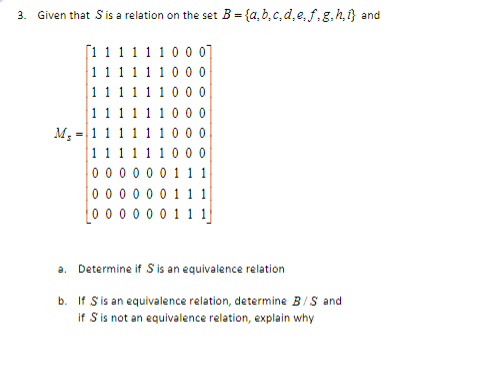
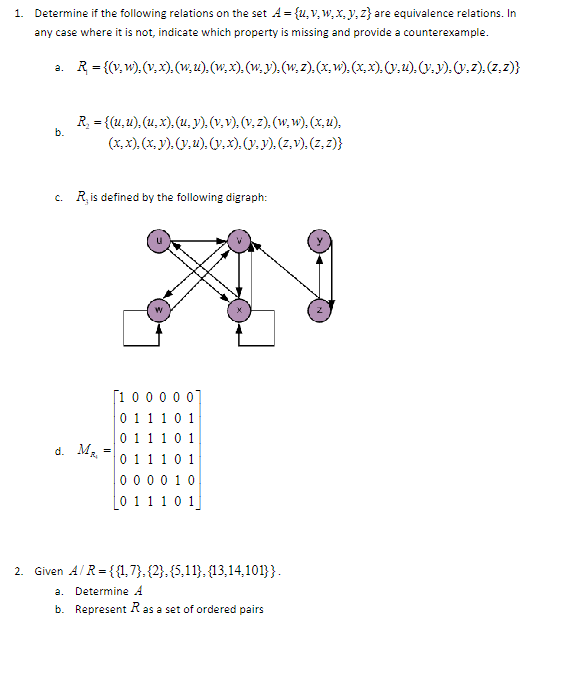
3. Given that S is a relation on the set B = (a, b, c, d, e, f, g. h, i) and 1111110007 1 1 1 1 1 1000 1 1 1 1 1 1000 11 1 1 1 1000 M. = 111111000 1 1 1 1 1 1000 0000001 11 00 0 0 0 01 11 000000111 a. Determine if S is an equivalence relation b. If S is an equivalence relation, determine B/ S and if S is not an equivalence relation, explain why1. Determine if the following relations on the set A= (u, V, w, x, y, z) are equivalence relations. In any case where it is not, indicate which property is missing and provide a counterexample. a. R = ((v:W).(vx). (wu). (wx). (wy).(w.z).(x, w). (xx). (v.u). (v.y). (v.z),(zz)} b. R, = {(u, u), (u, x), (u. V). (v. V). (v. z). (w. W). (x, u). ( x, x ) . ( x , V ) . ( v . u ) . ( x) . (V V). (z, V). (z z)} c. R, is defined by the following digraph: 1000007 01 1 101 01 1 101 d. MR = 01 1 101 0 0 0 010 011 101 2. Given A/ R = { {1. 7). (2): {5.11) (13,14,101}}. a. Determine A b. Represent Rasa set of ordered pairs
Step by Step Solution
There are 3 Steps involved in it

Get step-by-step solutions from verified subject matter experts
 Study Help