







Question: 3) identify the p value 4) make a decision addressing the hypotheses Points: 0.17 of 1 Homework: HW 14: Ch 8 & 9 - Inferences
3) identify the p value 4) make a decision addressing the hypotheses
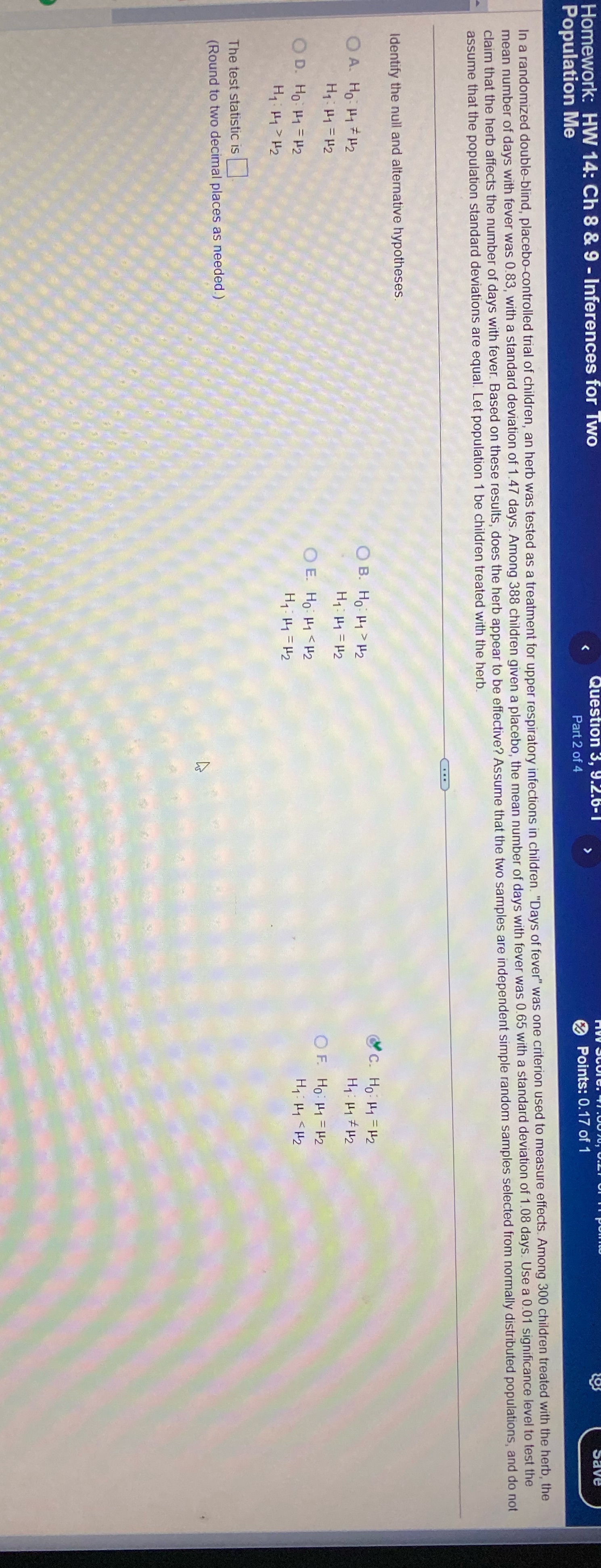
Points: 0.17 of 1 Homework: HW 14: Ch 8 & 9 - Inferences for T Part 2 of 4 Population Me In a randomized double-blind, placebo-controlled trial of children, an herb was tested as a treatment for upper respiratory infections in children. "Days of fever" was one criterion used to measure effects. Among 300 children treated with the herb, the mean number of days with fever was 0.83, with a standard deviation of 1.47 days. Among 388 children given a placebo, the mean number of days with fever was 0.65 with a standard deviation of 1.08 days. Use a 0.01 significance level to test the claim that the herb affects the number of days with fever. Based on these results, does the herb appear to be effective? Assume that the two samples are independent simple random samples selected from normally distributed populations, and do not assume that the population standard deviations are equal. Let population 1 be children treated with the herb. Identify the null and alternative hypotheses. &C. Ho Hy = H2 OB. HO H1 > H2 H1: My * H 2 OA. HO Hy# H2 H1: My = H2 OF. HO H1 = H2 Hy My = H 2 OE. HO- My H 2 The test statistic is (Round to two decimal places as needed.)
Step by Step Solution
There are 3 Steps involved in it

Get step-by-step solutions from verified subject matter experts
 Study Help