







Question: 3. In Figure 3, the spring is initially at the static equilibrium position. Solve the following problems: (a) Select coordinates and obtain kinematic constraint
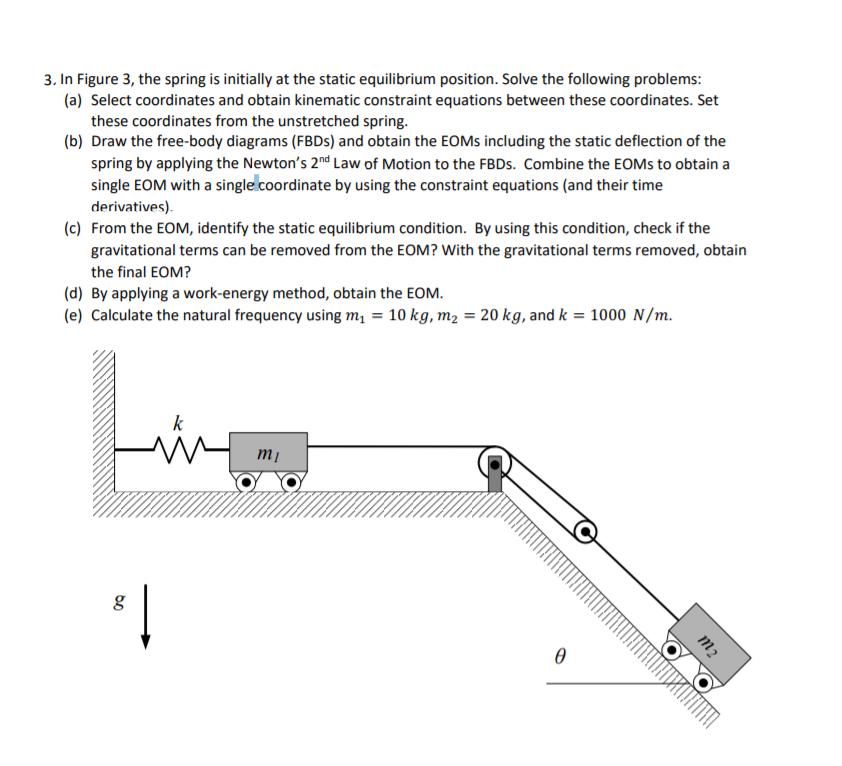
3. In Figure 3, the spring is initially at the static equilibrium position. Solve the following problems: (a) Select coordinates and obtain kinematic constraint equations between these coordinates. Set these coordinates from the unstretched spring. (b) Draw the free-body diagrams (FBDs) and obtain the EOMS including the static deflection of the spring by applying the Newton's 2nd Law of Motion to the FBDs. Combine the EOMs to obtain a single EOM with a single coordinate by using the constraint equations (and their time derivatives). (c) From the EOM, identify the static equilibrium condition. By using this condition, check if the gravitational terms can be removed from the EOM? With the gravitational terms removed, obtain the final EOM? (d) By applying a work-energy method, obtain the EOM. (e) Calculate the natural frequency using m = 10 kg, m = 20 kg, and k = 1000 N/m. g k m 0 m2
Step by Step Solution
3.39 Rating (152 Votes )
There are 3 Steps involved in it
a 6 K Lo Mi x 48 mass m moves by x my will move negoud static defl... View full answer

Get step-by-step solutions from verified subject matter experts
 Study Help