







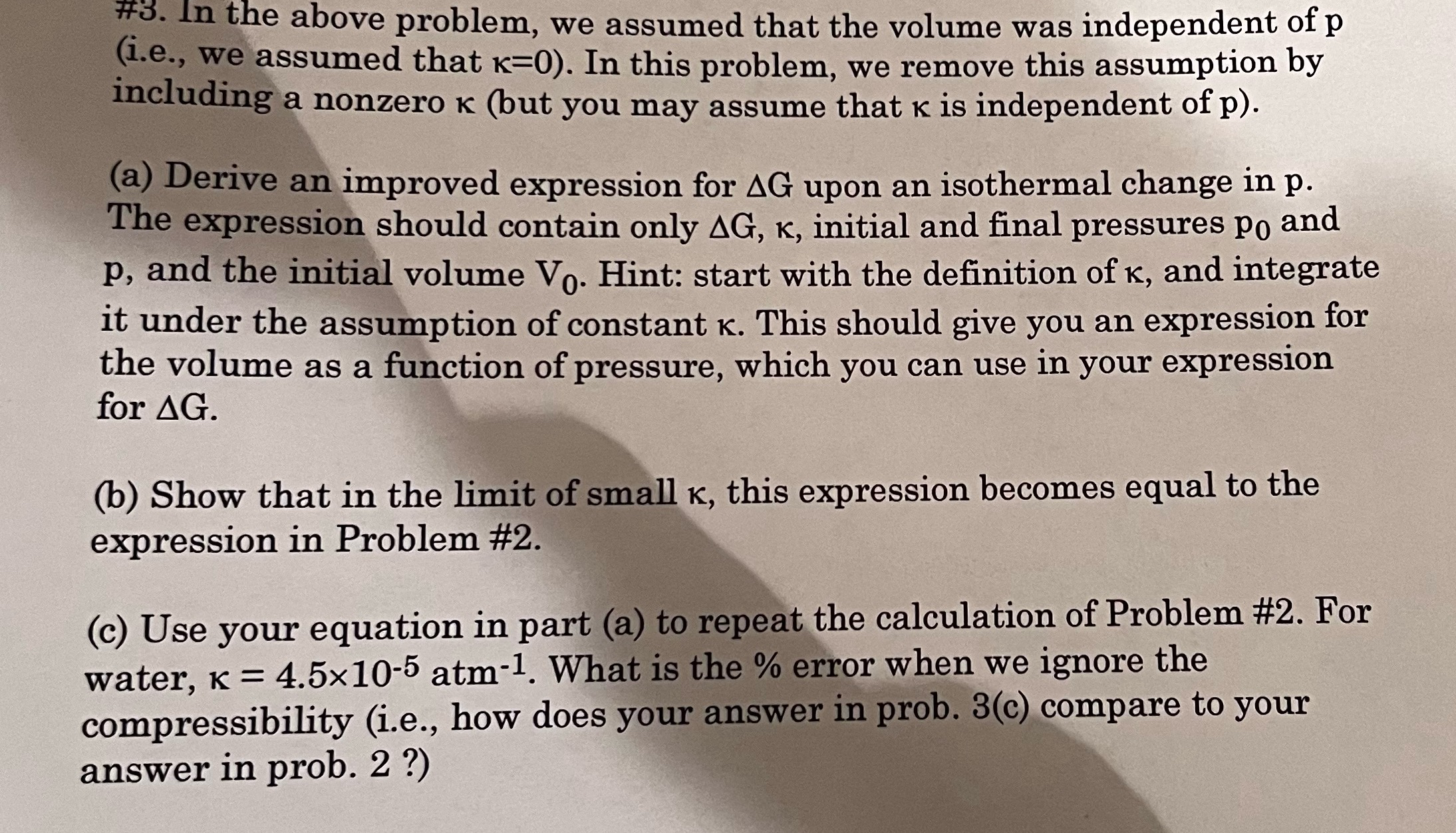
Question: # 3 . In the above problem, we assumed that the volume was independent of p ( i . e . , we assumed that
# In the above problem, we assumed that the volume was independent of ie we assumed that In this problem, we remove this assumption by including a nonzero but you may assume that is independent of
a Derive an improved expression for upon an isothermal change in The expression should contain only initial and final pressures and and the initial volume Hint: start with the definition of and integrate it under the assumption of constant This should give you an expression for the volume as a function of pressure, which you can use in your expression for
b Show that in the limit of small this expression becomes equal to the expression in Problem #
c Use your equation in part a to repeat the calculation of Problem # For water, What is the error when we ignore the compressibility ie how does your answer in prob. c compare to your answer in prob.
Info from previous question cm of liquid water at C is isothermally compressed from atm to atm
Step by Step Solution
There are 3 Steps involved in it
1 Expert Approved Answer
Step: 1 Unlock

Question Has Been Solved by an Expert!
Get step-by-step solutions from verified subject matter experts
Step: 2 Unlock
Step: 3 Unlock
 Study Help