







Question: 3. In the remaining questions, you will generate simulated data that will help you think about the causal effect of tutoring on test scores. Specifically,
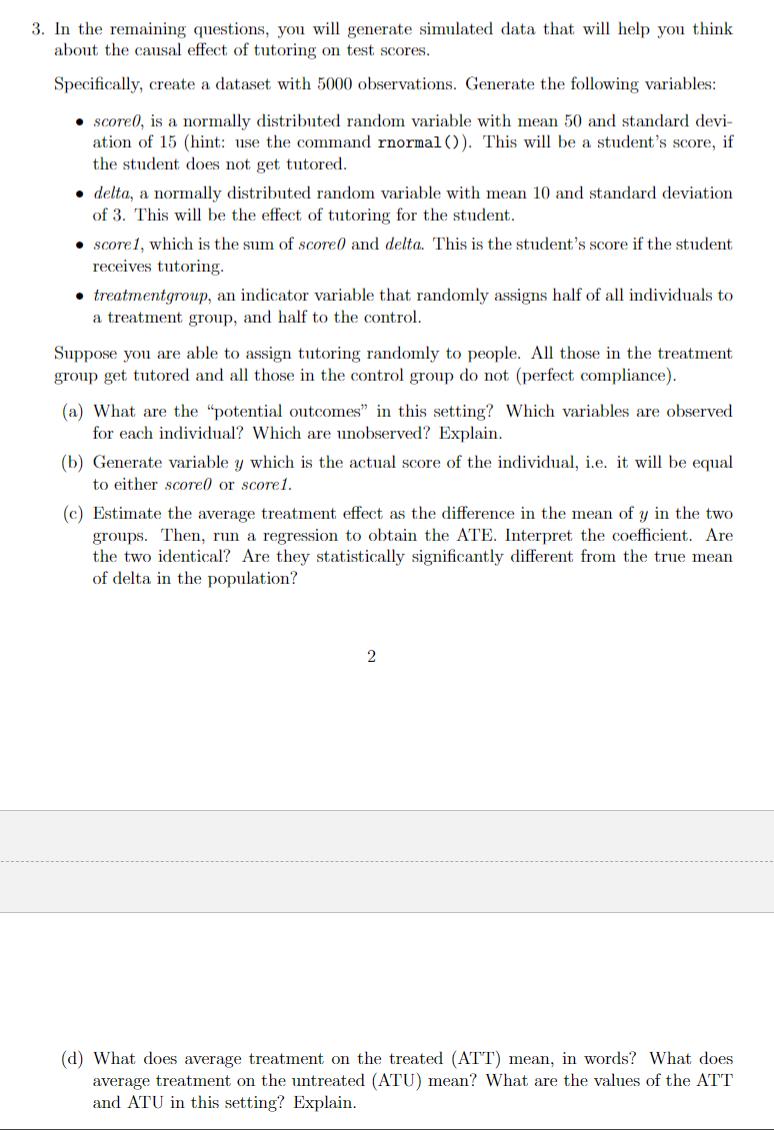
3. In the remaining questions, you will generate simulated data that will help you think about the causal effect of tutoring on test scores. Specifically, create a dataset with 5000 observations. Generate the following variables: . scored, is a normally distributed random variable with mean 50 and standard devi- ation of 15 (hint: use the command rnormal () ). This will be a student's score, if the student does not get tutored. . delta, a normally distributed random variable with mean 10 and standard deviation of 3. This will be the effect of tutoring for the student. . scored, which is the sum of scored and delta. This is the student's score if the student receives tutoring. . treatmentgroup, an indicator variable that randomly assigns half of all individuals to a treatment group, and half to the control. Suppose you are able to assign tutoring randomly to people. All those in the treatment group get tutored and all those in the control group do not (perfect compliance). (a) What are the "potential outcomes" in this setting? Which variables are observed for each individual? Which are unobserved? Explain. (b) Generate variable y which is the actual score of the individual, i.e. it will be equal to either scored or scorel. (c) Estimate the average treatment effect as the difference in the mean of y in the two groups. Then, run a regression to obtain the ATE. Interpret the coefficient. Are the two identical? Are they statistically significantly different from the true mean of delta in the population? (d) What does average treatment on the treated (ATT) mean, in words? What does average treatment on the untreated (ATU) mean? What are the values of the ATT and ATU in this setting? Explain
Step by Step Solution
There are 3 Steps involved in it

Get step-by-step solutions from verified subject matter experts
 Study Help