



Question: 3. It facilitates effective cost control. 4. It helps to identify the uneconomical activities. 5. It ensures the proper allocation of scarce resources on priority
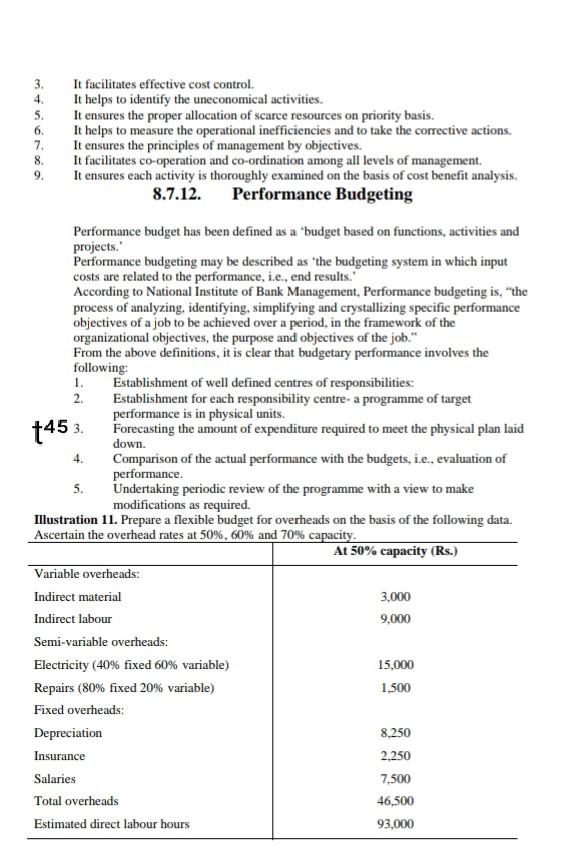
3. It facilitates effective cost control. 4. It helps to identify the uneconomical activities. 5. It ensures the proper allocation of scarce resources on priority basis. 6. It helps to measure the operational inefficiencies and to take the corrective actions. 7. It ensures the principles of management by objectives. 8 It facilitates co-operation and co-ordination among all levels of management. 9. It ensures each activity is thoroughly examined on the basis of cost benefit analysis. 8.7.12. Performance Budgeting Performance budget has been defined as a "budget based on functions, activities and projects. Performance budgeting may be described as "the budgeting system in which input costs are related to the performance, i.e., end results. According to National Institute of Bank Management, Performance budgeting is, "the process of analyzing, identifying, simplifying and crystallizing specific performance objectives of a job to be achieved over a period, in the framework of the organizational objectives, the purpose and objectives of the job." From the above definitions, it is clear that budgetary performance involves the following: 1. Establishment of well defined centres of responsibilities: 2. Establishment for each responsibility centre-a programme of target performance is in physical units. +45 3. Forecasting the amount of expenditure required to meet the physical plan laid down. 4. Comparison of the actual performance with the budgets, i.e., evaluation of performance 5. Undertaking periodic review of the programme with a view to make modifications as required. Illustration 11. Prepare a flexible budget for overheads on the basis of the following data. Ascertain the overhead rates at 50%. 60% and 70% capacity At 50% capacity (Rs.) Variable overheads: Indirect material 3.000 Indirect labour 9.000 Semi-variable overheads: Electricity (40% fixed 60% variable) 15,000 Repairs (80% fixed 20% variable) 1,500 Fixed overheads: Depreciation 8.250 Insurance 2.250 Salaries 7,500 Total overheads 46,500 Estimated direct labour hours 93,000
Step by Step Solution
There are 3 Steps involved in it

Get step-by-step solutions from verified subject matter experts