







Question: 3. Let (X, D) Be A Metric Space. Define D: XxXR By D(X, Y) = Min(1, D(X, Y). (A) Prove That D Is A Metric
3. Let (X, D) Be A Metric Space. Define D: XxXR By D(X, Y) = Min(1, D(X, Y). (A) Prove That D Is A Metric On X. (B) Let (Un)Ren Be A Sequence In X. Further Let : E X. Prove That X = D-Lim , If And Only If X=D- Lim... 100 4. Let X Be The Set Of All Continuous Function : (0,5) ? R Such That F Is Differentiable And F' Is Continuous. Define D: X X X + R By (8,9)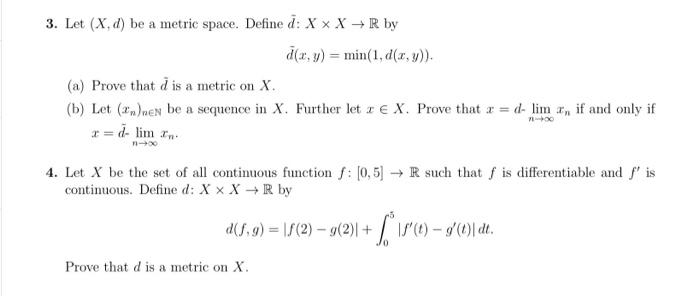
3. Let (X, d) be a metric space. Define d: XxX R by == d(x, y) = min(1, d(x, y)). (a) Prove that d is a metric on X. (b) Let (a)nen be a sequence in X. Further let z X. Prove that x=d- lim x, if and only if x = =d- lim n 117x 7118 4. Let X be the set of all continuous function : [0,5] R such that f is differentiable and f' is continuous. Define d: XxX R by d(f, 9) = f(2) = g(2)| + |* \$'(t) g'(t) \d - dt. Prove that d is a metric on X.
Step by Step Solution
There are 3 Steps involved in it

Get step-by-step solutions from verified subject matter experts
 Study Help