







Question: 3. (Multivariate Regression) (You should write your own R code instead of using the Im command to run the regression!) In order to study the
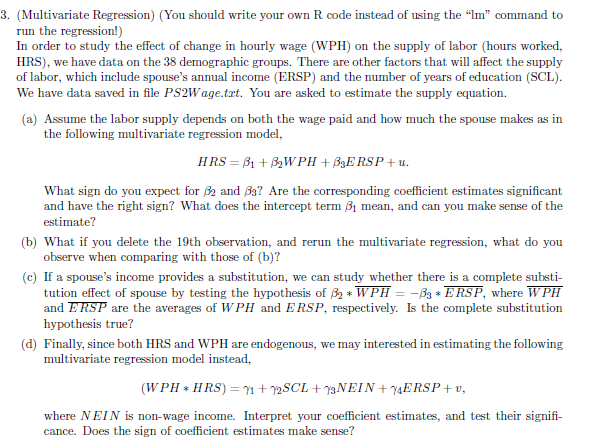
3. (Multivariate Regression) (You should write your own R code instead of using the Im" command to run the regression!) In order to study the effect of change in hourly wage (WPH) on the supply of labor (hours worked, HRS), we have data on the 38 demographic groups. There are other factors that will affect the supply of labor, which include spouse's annual income (ERSP) and the number of years of education (SCL). We have data saved in file PS2Wage.txt. You are asked to estimate the supply equation. (a) Assume the labor supply depends on both the wage paid and how much the spouse makes as in the following multivariate regression model, HRS =B1 + BW PH + B3E RSP+u. What sign do you expect for B2 and 33? Are the corresponding coefficient estimates significant and have the right sign? What does the intercept term Bi mean, and can you make sense of the estimate? (b) What if you delete the 19th observation, and rerun the multivariate regression, what do you observe when comparing with those of (b)? (c) If a spouse's income provides a substitution, we can study whether there is a complete substi- tution effect of spouse by testing the hypothesis of B2 * WPH = -B3 * ERSP, where WPH and ERSP are the averages of WPH and ERSP, respectively. Is the complete substitution hypothesis true? (d) Finally, since both HRS and WPH are endogenous, we may interested in estimating the following multivariate regression model instead, (WPH HRS) = 71+ 72SCL + 73NEIN + VERSP+v, where NEIN is non-wage income. Interpret your coefficient estimates, and test their signifi- cance. Does the sign of coefficient estimates make sense? 3. (Multivariate Regression) (You should write your own R code instead of using the Im" command to run the regression!) In order to study the effect of change in hourly wage (WPH) on the supply of labor (hours worked, HRS), we have data on the 38 demographic groups. There are other factors that will affect the supply of labor, which include spouse's annual income (ERSP) and the number of years of education (SCL). We have data saved in file PS2Wage.txt. You are asked to estimate the supply equation. (a) Assume the labor supply depends on both the wage paid and how much the spouse makes as in the following multivariate regression model, HRS =B1 + BW PH + B3E RSP+u. What sign do you expect for B2 and 33? Are the corresponding coefficient estimates significant and have the right sign? What does the intercept term Bi mean, and can you make sense of the estimate? (b) What if you delete the 19th observation, and rerun the multivariate regression, what do you observe when comparing with those of (b)? (c) If a spouse's income provides a substitution, we can study whether there is a complete substi- tution effect of spouse by testing the hypothesis of B2 * WPH = -B3 * ERSP, where WPH and ERSP are the averages of WPH and ERSP, respectively. Is the complete substitution hypothesis true? (d) Finally, since both HRS and WPH are endogenous, we may interested in estimating the following multivariate regression model instead, (WPH HRS) = 71+ 72SCL + 73NEIN + VERSP+v, where NEIN is non-wage income. Interpret your coefficient estimates, and test their signifi- cance. Does the sign of coefficient estimates make sense
Step by Step Solution
There are 3 Steps involved in it

Get step-by-step solutions from verified subject matter experts
 Study Help