







Question: 3. Now let's do some differential equations and physics! dog. A. A differential equation that describes the velocity of an object in free fall is
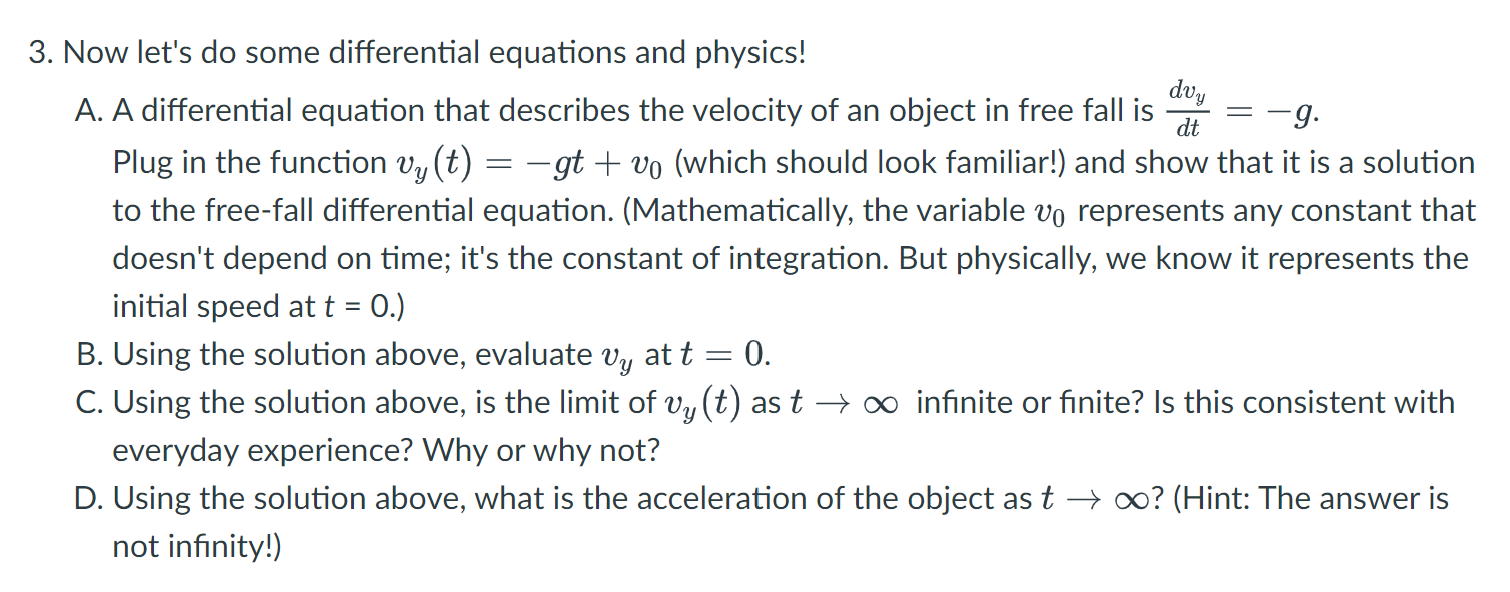
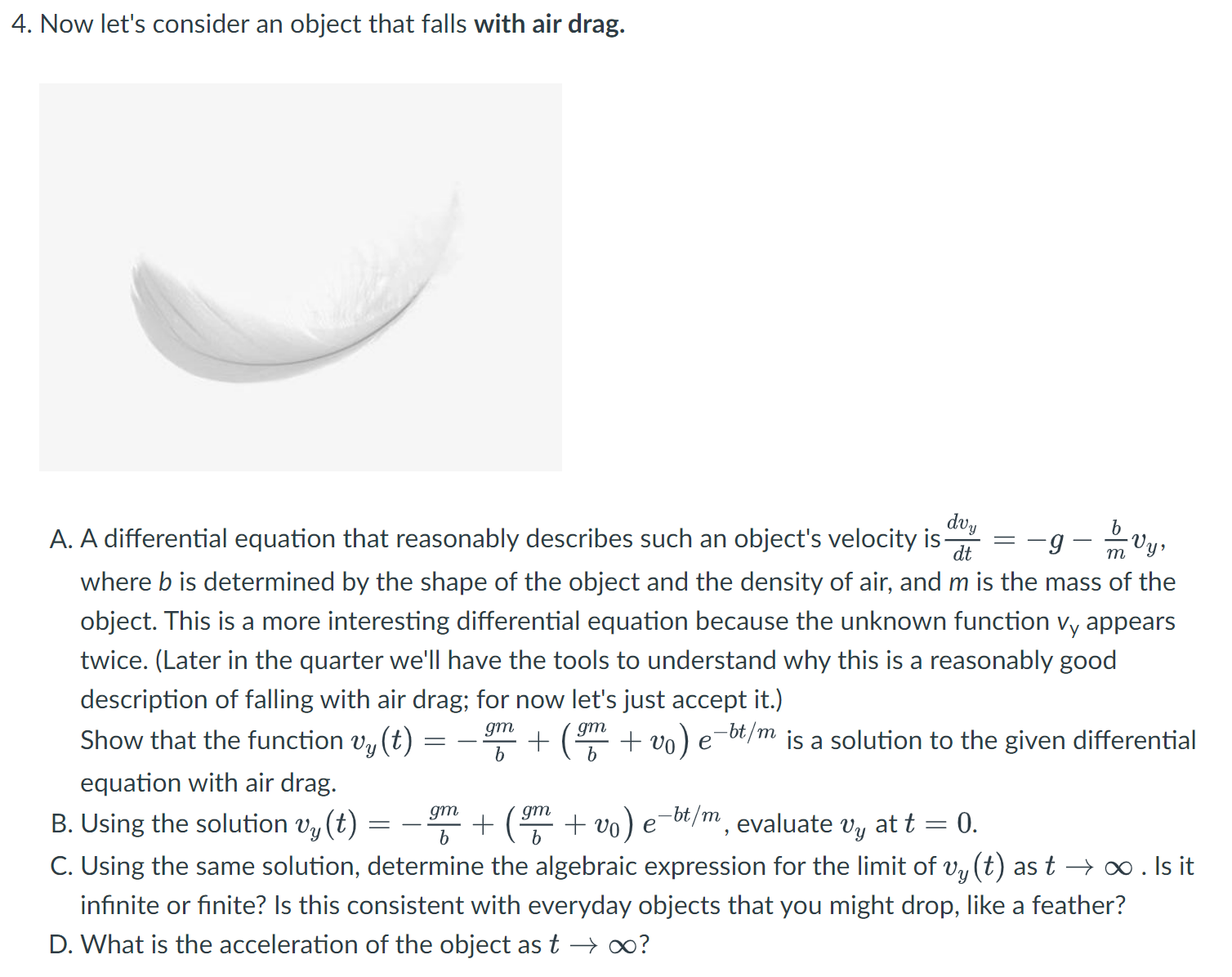
3. Now let's do some differential equations and physics! dog. A. A differential equation that describes the velocity of an object in free fall is E = *9 Plug in the function '03; (t) = gt l 110 (which should look familiar!) and show that it is a solution to the free-fall differential equation. (Mathematically, the variable v0 represents any constant that doesn't depend on time; it's the constant of integration. But physically, we know it represents the initial speed at t = O.) B. Using the solution above, evaluate \"US; at t = 0. C. Using the solution above, is the limit of 113, (t) as t % oo infinite or nite? Is this consistent with everyday experience? Why or why not? D. Using the solution above, what is the acceleration of the object as t % oo? (Hint: The answer is not innity!) 4. Now let's consider an object that falls with air drag. dog 1) A. A differential equation that reasonably describes such an object's velocity is? : g Evy, where b is determined by the shape of the object and the density of air, and m is the mass of the object. This is a more interesting differential equation because the unknown function vy appears twice. (Later in the quarter we'll have the tools to understand why this is a reasonably good description of falling with air drag; for now let's just accept it.) Show that the function by (t) = 7% ($ + '00) e'bt/m' is a solution to the given differential equation with air drag. B. Using the solution vy (t) = $ + ($ l 710) e'bt/m, evaluate vy att = 0. C. Using the same solution, determine the algebraic expression for the limit of 11905) as t % oo . Is it infinite or nite? Is this consistent with everyday objects that you might drop, like a feather? D. What is the acceleration of the object as t > 00
Step by Step Solution
There are 3 Steps involved in it

Get step-by-step solutions from verified subject matter experts
 Study Help