



Question: 3. Oh dear. I was trying to understand the base cases of the above algorithm and I came up with a much easier algorithm. Instead
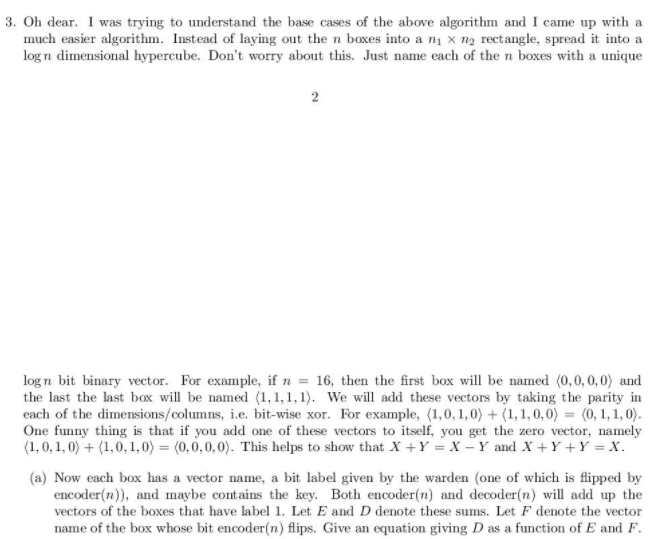
3. Oh dear. I was trying to understand the base cases of the above algorithm and I came up with a much easier algorithm. Instead of laying out the n boxes into a ni x 12 rectangle, spread it into a log n dimensional hypercube. Don't worry about this. Just name each of the n boxes with a unique 2 log n bit binary vector. For example, if n = 16, then the first box will be named (0,0,0,0) and the last the last box will be named (1,1,1,1). We will add these vectors by taking the parity in each of the dimensions/columns, i.e. bit-wise xor. For example, (1,0,1,0) + (1,1,0,0) = (0,1,1,0). One funny thing is that if you add one of these vectors to itself, you get the zero vector, namely (1,0,1,0) + (1,0,1,0) = (0,0,0,0). This helps to show that X + Y = X - Y and X+Y+Y = X. (a) Now each box has a vector name, a bit label given by the warden (one of which is flipped by encoder(n)), and maybe contains the key. Both encoder(n) and decoder(n) will add up the vectors of the boxes that have label 1. Let E and D denote these sums. Let F denote the vector name of the box whose bit encoder(n) flips. Give an equation giving D as a function of E and F. 3. Oh dear. I was trying to understand the base cases of the above algorithm and I came up with a much easier algorithm. Instead of laying out the n boxes into a ni x 12 rectangle, spread it into a log n dimensional hypercube. Don't worry about this. Just name each of the n boxes with a unique 2 log n bit binary vector. For example, if n = 16, then the first box will be named (0,0,0,0) and the last the last box will be named (1,1,1,1). We will add these vectors by taking the parity in each of the dimensions/columns, i.e. bit-wise xor. For example, (1,0,1,0) + (1,1,0,0) = (0,1,1,0). One funny thing is that if you add one of these vectors to itself, you get the zero vector, namely (1,0,1,0) + (1,0,1,0) = (0,0,0,0). This helps to show that X + Y = X - Y and X+Y+Y = X. (a) Now each box has a vector name, a bit label given by the warden (one of which is flipped by encoder(n)), and maybe contains the key. Both encoder(n) and decoder(n) will add up the vectors of the boxes that have label 1. Let E and D denote these sums. Let F denote the vector name of the box whose bit encoder(n) flips. Give an equation giving D as a function of E and F
Step by Step Solution
There are 3 Steps involved in it

Get step-by-step solutions from verified subject matter experts