







Question: [3 points] Give the Taylor's series for the function f(x) = cos x about the point 0, writing explicitly all terms of the Taylor polynomial
![[3 points] Give the Taylor's series for the function f(x) =](https://dsd5zvtm8ll6.cloudfront.net/si.experts.images/questions/2024/09/66f302cd3d68e_99666f302cc9906a.jpg)
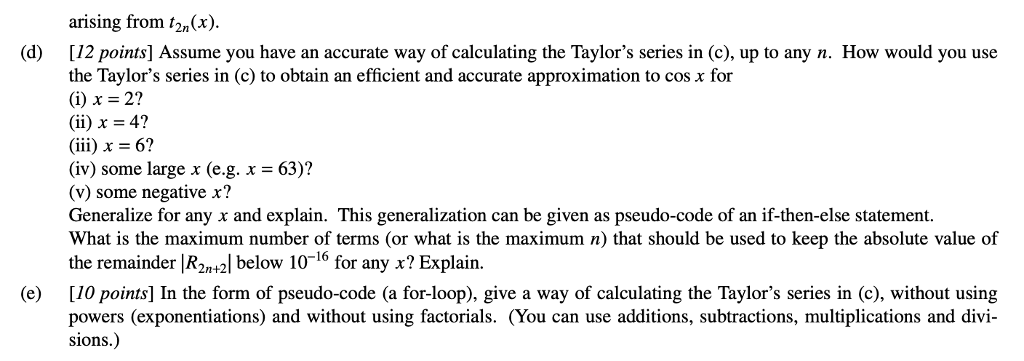
[3 points] Give the Taylor's series for the function f(x) = cos x about the point 0, writing explicitly all terms of the Taylor polynomial t4(x) of degree 4 and the remainder R6. Note that there are only 3 non-zero terms in t4(x). Indicate t4(x) and R6. Note that the remainder involves x and an unknown c. Indicate the (smallest) interval where c lies [5 points] Using t4(x) approximate cos 1. Indicate the approximate value in 5 significant decimals. Using R6, give an upper bound (as sharp as you can) for the (absolute value of the) error of the approximation to cos 1. Explain how you got the bound. [5 points] Give the Taylor's series for f(x) = cos x about the point 0, in a form so that the (2n)th term (for a general n) of the Taylor polynomial t2n(x) of degree 2n and the remainder R2n+2 are shown explicitly. Using R2n+2, give, in terms of n and x, an upper bound (as sharp as you can) for the (absolute value of the) error in the approximation to cos x (a) (b) (c) arising from t2n(x). (d) 12 points] Assume you have an accurate way of calculating the Taylor's series in (c), up to any n. How would you use the Taylor's series in (c) to obtain an efficient and accurate approximation to cos x for (i) x 2? (ii) x = 4? (iii) x 6? iv) some large x (e.g. x 63)? (v) some negative x? Generalize for any x and explain. This generalization can be given as pseudo-code of an if-then-else statement. What is the maximum number of terms (or what is the maximum n) that should be used to keep the absolute value of the remainder |R2mt2l below 10-16 for any x? Explain. (e) I0 points] In the form of pseudo-code (a for-loop), give a way of calculating the Taylor's series in (c), without using powers (exponentiations) and without using factorials. (You can use additions, subtractions, multiplications and div sions.)
Step by Step Solution
There are 3 Steps involved in it

Get step-by-step solutions from verified subject matter experts
 Study Help