







Question: 3. Problems and Applications Q8 A case study in the chapter analyzed purchasing-power parity for several countries using the price of Big Macs. Here are
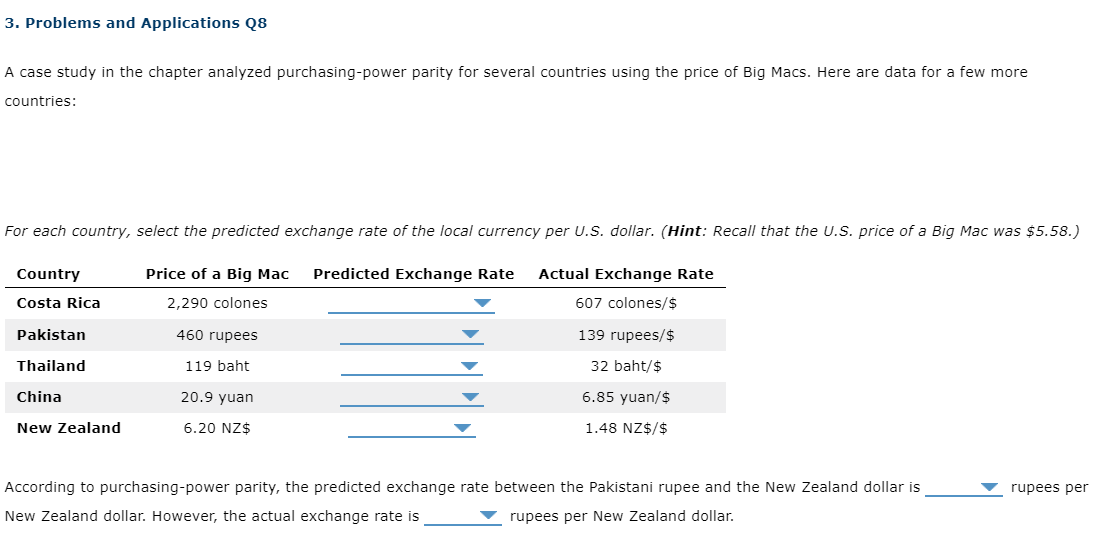
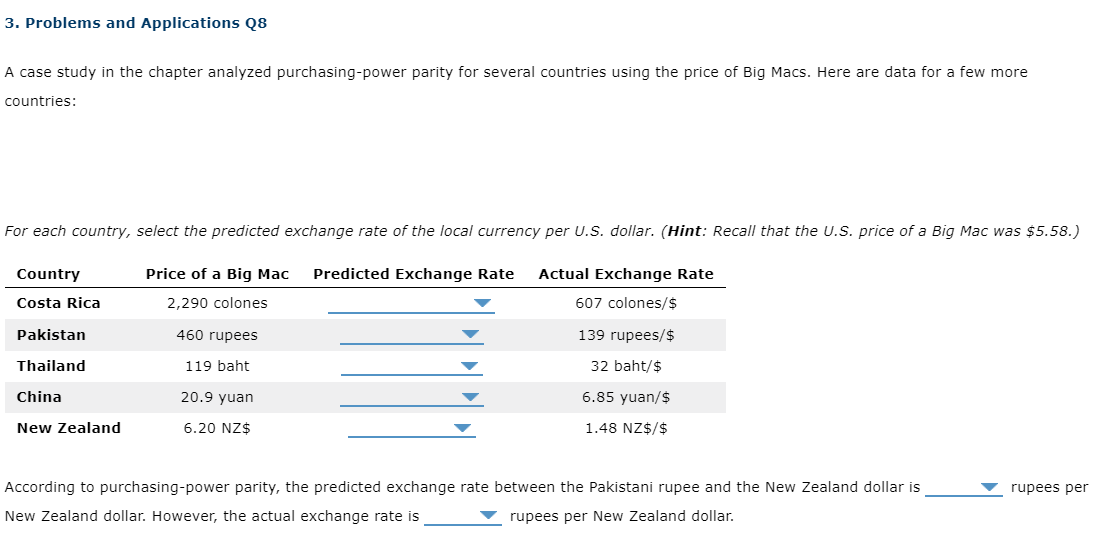
3. Problems and Applications Q8 A case study in the chapter analyzed purchasing-power parity for several countries using the price of Big Macs. Here are data for a few more countries: For each country, select the predicted exchange rate of the local currency per U.S. dollar. (Hint: Recall that the U.S. price of a Big Mac was $5.58.) Country Price of a Big Mac Predicted Exchange Rate Actual Exchange Rate Costa Rica 2,290 colones 607 colones/$ Pakistan 460 rupees 139 rupees/$ Thailand 119 baht 32 baht/$ China 20.9 yuan 6.85 yuan/$ New Zealand 6.20 NZ$ 1.48 NZ$/$ According to purchasing-power parity, the predicted exchange rate between the Pakistani rupee and the New Zealand dollar is rupees per New Zealand dollar. However, the actual exchange rate is rupees per New Zealand dollar
Step by Step Solution
There are 3 Steps involved in it

Get step-by-step solutions from verified subject matter experts
 Study Help