







Question: 3. Raymond consumes only bread. In year 1, rye bread costs $2.02 per loaf, and white bread costs $2.75 per loaf. Raymond buys 4
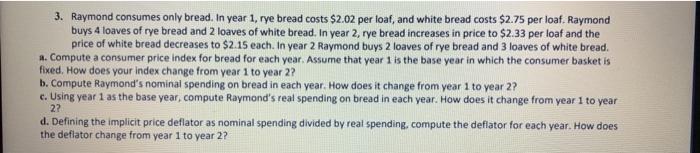


3. Raymond consumes only bread. In year 1, rye bread costs $2.02 per loaf, and white bread costs $2.75 per loaf. Raymond buys 4 loaves of rye bread and 2 loaves of white bread. In year 2, rye bread increases in price to $2.33 per loaf and the price of white bread decreases to $2.15 each. In year 2 Raymond buys 2 loaves of rye bread and 3 loaves of white bread. a. Compute a consumer price index for bread for each year. Assume that year 1 is the base year in which the consumer basket is fixed. How does your index change from year 1 to year 2? b. Compute Raymond's nominal spending on bread in each year. How does it change from year 1 to year 2? c. Using year 1 as the base year, compute Raymond's real spending on bread in each year. How does it change from year 1 to year 2? d. Defining the implicit price deflator as nominal spending divided by real spending, compute the deflator for each year. How does the deflator change from year 1 to year 2? 4. This question concerns the macroeconomic implications of COVID-19 pandemic. a. What are 3 economic policies the Canadian or Manitoban government has used to prevent a deep recession from occurring in Canada/Manitoba during this pandemic? b. What is your opinion on how the Canadian or Manitoban government has handled the economic side of this pandemic? Please give at least 2 reasons for your opinion. 2. Write down demand and supply equations for fertilizer. Include two exogenous variables in each equation. a. Draw a supply-demand graph for fertilizer. b. Use your graph to show how a change in one of your exogenous variables affects the model's endogenous variables.
Step by Step Solution
3.41 Rating (157 Votes )
There are 3 Steps involved in it
a Consumer price index CPI for bread Year 1 Rye bread cost per loaf 202 White bread cost per loaf 275 CPI Year 1 Price of rye bread in Year 1 Quantity of rye bread in Year 1 Price of white bread in Ye... View full answer

Get step-by-step solutions from verified subject matter experts
 Study Help