







Question: 3. Suppose two hosts, A and B, are separated by 24,000 kilometers and are connected by a direct link of R = 5 Mbps. Suppose
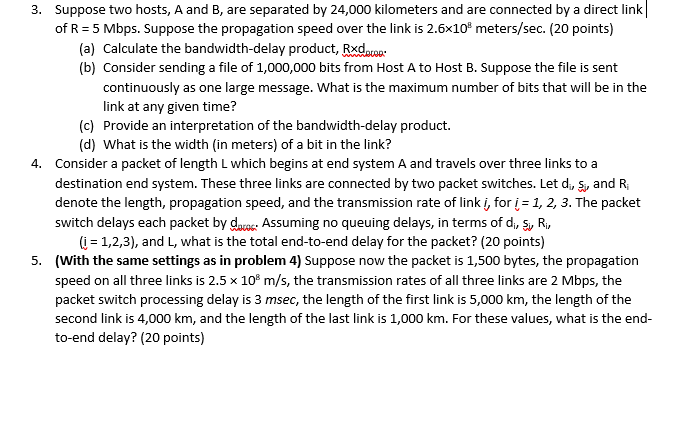
3. Suppose two hosts, A and B, are separated by 24,000 kilometers and are connected by a direct link of R = 5 Mbps. Suppose the propagation speed over the link is 2.6x10 meters/sec. (20 points) (a) Calculate the bandwidth-delay product, Rxdocoa (b) Consider sending a file of 1,000,000 bits from Host A to Host B. Suppose the file is sent continuously as one large message. What is the maximum number of bits that will be in the link at any given time? (c) Provide an interpretation of the bandwidth-delay product. (d) What is the width (in meters) of a bit in the link? 4. Consider a packet of length L which begins at end system A and travels over three links to a destination end system. These three links are connected by two packet switches. Let di, s, and R; denote the length, propagation speed, and the transmission rate of link i, for i = 1, 2, 3. The packet switch delays each packet by davac: Assuming no queuing delays, in terms of di, , Ri (i = 1,2,3), and L, what is the total end-to-end delay for the packet? (20 points) 5. (With the same settings as in problem 4) Suppose now the packet is 1,500 bytes, the propagation speed on all three links is 2.5 x 10 m/s, the transmission rates of all three links are 2 Mbps, the packet switch processing delay is 3 msec, the length of the first link is 5,000 km, the length of the second link is 4,000 km, and the length of the last link is 1,000 km. For these values, what is the end- to-end delay? (20 points)
Step by Step Solution
There are 3 Steps involved in it

Get step-by-step solutions from verified subject matter experts
 Study Help