







Question: 3. Suppose you have two fair dice, each with 6 faces. . One die is coloured blue and has the following faces: {1, 1, 1,
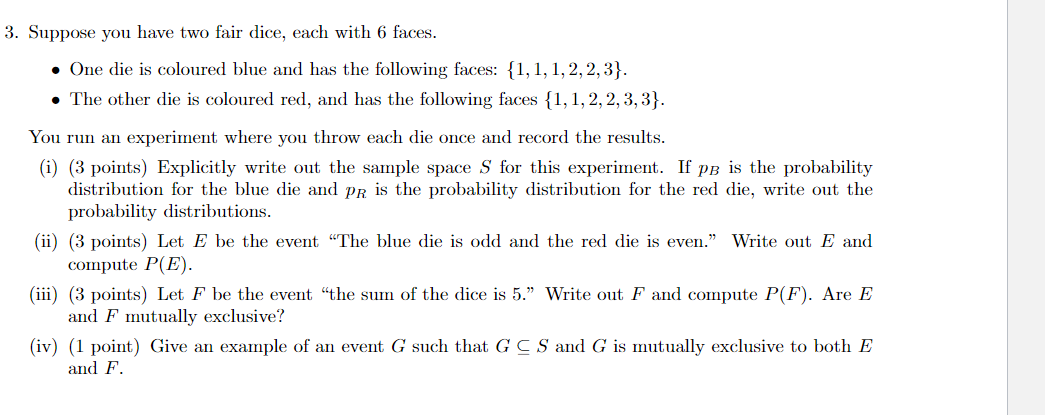
3. Suppose you have two fair dice, each with 6 faces. . One die is coloured blue and has the following faces: {1, 1, 1, 2, 2, 3}. . The other die is coloured red, and has the following faces {1, 1, 2, 2, 3, 3}. You run an experiment where you throw each die once and record the results. (i) (3 points) Explicitly write out the sample space S for this experiment. If pp is the probability distribution for the blue die and pr is the probability distribution for the red die, write out the probability distributions. (ii) (3 points) Let E be the event "The blue die is odd and the red die is even." Write out E and compute P(E). (iii) (3 points) Let F be the event "the sum of the dice is 5." Write out F and compute P(F). Are E and F mutually exclusive? (iv) (1 point) Give an example of an event G such that G C S and G is mutually exclusive to both E and F
Step by Step Solution
There are 3 Steps involved in it

Get step-by-step solutions from verified subject matter experts
 Study Help