







Question: Table 1 Determine the deflections at the centre of rectangular plates (1000 mm x 2000 mm) under uniformly distributed load (UDL) q = 1.0
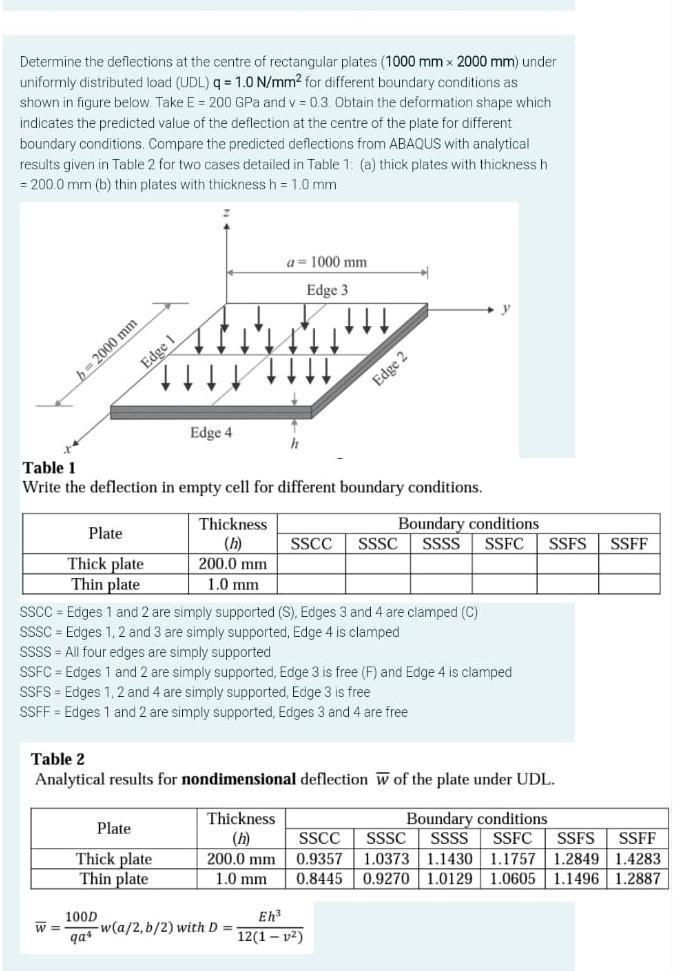
Table 1 Determine the deflections at the centre of rectangular plates (1000 mm x 2000 mm) under uniformly distributed load (UDL) q = 1.0 N/mm for different boundary conditions as shown in figure below. Take E = 200 GPa and v = 0.3. Obtain the deformation shape which indicates the predicted value of the deflection at the centre of the plate for different boundary conditions. Compare the predicted deflections from ABAQUS with analytical results given in Table 2 for two cases detailed in Table 1: (a) thick plates with thickness h =200.0 mm (b) thin plates with thickness h = 1.0 mm b=2000 mm Edge 1 Edge 4 a=1000 mm Edge 3 Edge 2 Write the deflection in empty cell for different boundary conditions. Plate Thick plate Thickness (h) Boundary conditions SSCC SSSC SSSS SSFC SSFS SSFF 200.0 mm Thin plate 1.0 mm SSCC = Edges 1 and 2 are simply supported (S), Edges 3 and 4 are clamped (C) SSSC Edges 1, 2 and 3 are simply supported, Edge 4 is clamped SSSS - All four edges are simply supported SSFC - Edges 1 and 2 are simply supported, Edge 3 is free (F) and Edge 4 is clamped SSFS - Edges 1, 2 and 4 are simply supported, Edge 3 is free SSFF = Edges 1 and 2 are simply supported, Edges 3 and 4 are free Table 2 Analytical results for nondimensional deflection W of the plate under UDL. Plate Thick plate Thickness (h) 200.0 mm Thin plate 1.0 mm 100D W= w(a/2,b/2) with D=- qa Eh 12(1-v2) Boundary conditions SSCC SSSC SSSS SSFC SSFS SSFF 0.9357 1.0373 1.1430 1.1757 1.2849 1.4283 0.8445 0.9270 1.0129 1.0605 1.1496 1.2887
Step by Step Solution
3.37 Rating (153 Votes )
There are 3 Steps involved in it

Get step-by-step solutions from verified subject matter experts
 Study Help