


Question: 3. The less the other party values an issue, the lower his or her resistance point will be. A. True B. False 4. Distributive bargaining
3. The less the other party values an issue, the
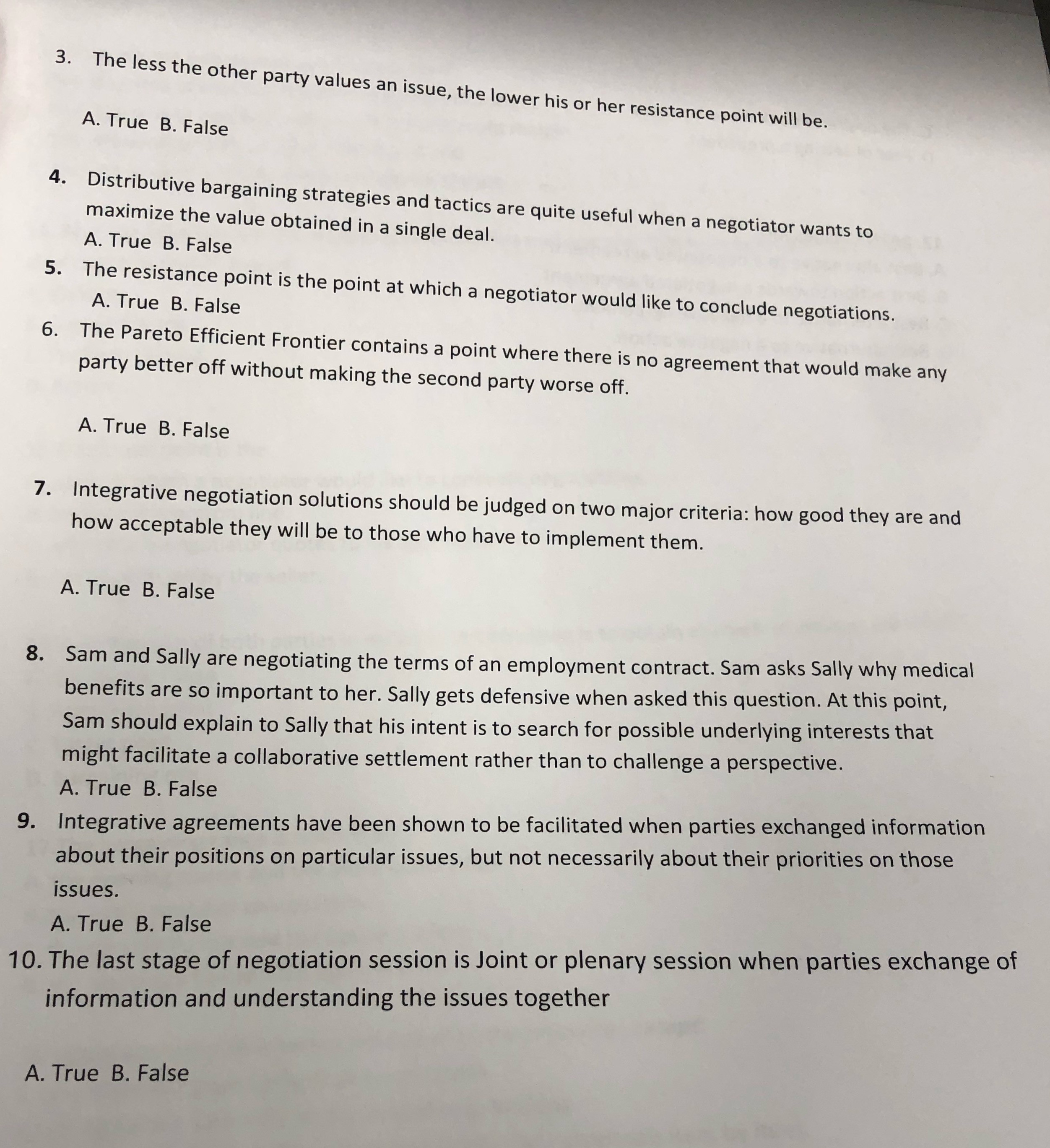
3. The less the other party values an issue, the lower his or her resistance point will be. A. True B. False 4. Distributive bargaining strategies and tactics are quite useful when a negotiator wants to maximize the value obtained in a single deal. A. True B. False 5. The resistance point is the point at which a negotiator would like to conclude negotiations. A. True B. False 6. The Pareto Efficient Frontier contains a point where there is no agreement that would make any party better off without making the second party worse off. A. True B. False 7. Integrative negotiation solutions should be judged on two major criteria: how good they are and how acceptable they will be to those who have to implement them. A. True B. False 8. Sam and Sally are negotiating the terms of an employment contract. Sam asks Sally why medical benefits are so important to her. Sally gets defensive when asked this question. At this point, Sam should explain to Sally that his intent is to search for possible underlying interests that might facilitate a collaborative settlement rather than to challenge a perspective. A. True B. False 9. Integrative agreements have been shown to be facilitated when parties exchanged information about their positions on particular issues, but not necessarily about their priorities on those issues. A. True B. False 10. The last stage of negotiation session is Joint or plenary session when parties exchange of information and understanding the issues together A. True B. False

Step by Step Solution

There are 3 Steps involved in it

1 Expert Approved Answer
Step: 1 Unlock blur-text-image

Question Has Been Solved by an Expert!

Get step-by-step solutions from verified subject matter experts

Step: 2 Unlock
Step: 3 Unlock

Students Have Also Explored These Related Human Resource Management Questions!