







Question: 3 The Logistic Map The examples we saw above are both ordinary differential equations with at least three different components that need to be solved
The Logistic Map
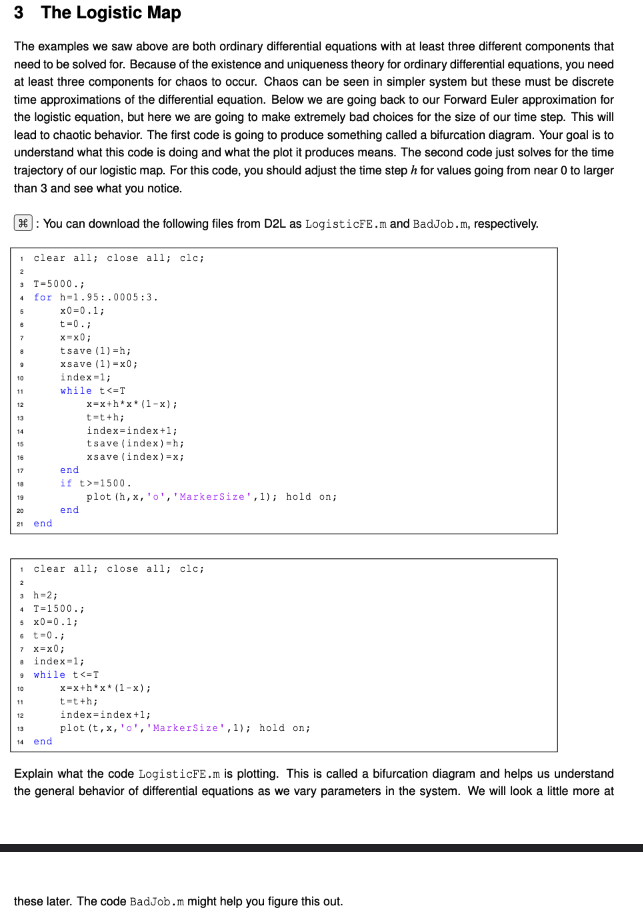
The examples we saw above are both ordinary differential equations with at least three different components that need to be solved for. Because of the existence and uniqueness theory for ordinary differential equations, you need at least three components for chaos to occur. Chaos can be seen in simpler system but these must be discrete time approximations of the differential equation. Below we are going back to our Forward Euler approximation for the logistic equation, but here we are going to make extremely bad choices for the size of our time step. This will lead to chaotic behavior. The first code is going to produce something called a bifurcation diagram. Your goal is to understand what this code is doing and what the plot it produces means. The second code just solves for the time trajectory of our logistic map. For this code, you should adjust the time step h for values going from near to larger than and see what you notice.
: You can download the following files from DL as LogisticFE.m and BadJob.m respectively.
clear all; close all; clc;
T;
for h::
t;
xx;
tsave h;
xsave x;
index;
while tT
xxhxx;
tth;
indexindex;
tsaveindexh;
xsaveindexx;
end
if t
plothx'MarkerSize',; hold on;
end
end
clear all; close all; clc;
h;
T;
x;
t;
xx;
index;
while tT
xxhxx;
tth;
indexindex;
plottx'MarkerSize',; hold on;
end
Explain what the code LogisticFE.m is plotting. This is called a bifurcation diagram and helps us understand the general behavior of differential equations as we vary parameters in the system. We will look a little more at
Step by Step Solution
There are 3 Steps involved in it
1 Expert Approved Answer
Step: 1 Unlock

Question Has Been Solved by an Expert!
Get step-by-step solutions from verified subject matter experts
Step: 2 Unlock
Step: 3 Unlock
 Study Help