







Question: 3. The network below uses the distance-vector routing algorithm. Assume the following: Links have the same cost in both directions. Nodes exchange their routing info
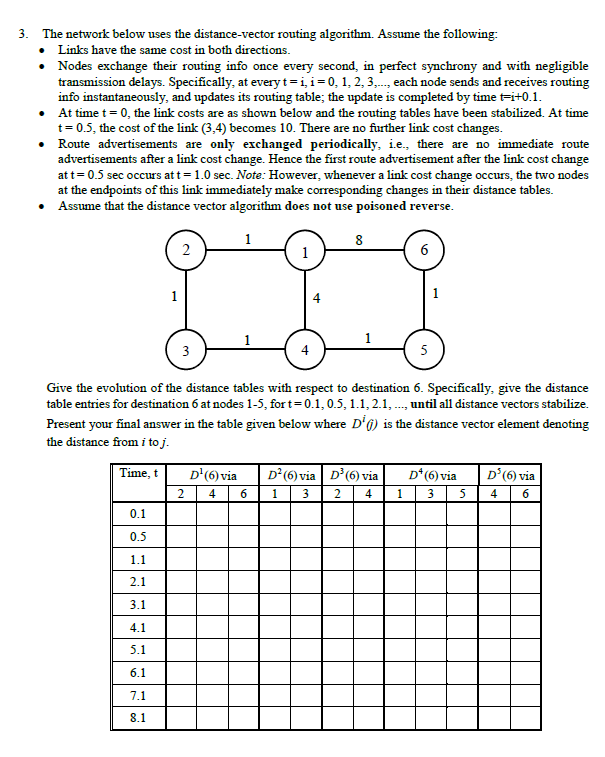
3. The network below uses the distance-vector routing algorithm. Assume the following: Links have the same cost in both directions. Nodes exchange their routing info once every second, in perfect synchrony and with negligible transmission delays. Specifically, at everytri,i= 0, 1, 2, 3...., each node sends and receives routing info instantaneously, and updates its routing table; the update is completed by time t=i+0.1. At time t = 0, the link costs are as shown below and the routing tables have been stabilized. At time t=0.5, the cost of the link (3.4) becomes 10. There are no further link cost changes. Route advertisements are only exchanged periodically, i.e., there are no immediate route advertisements after a link cost change. Hence the first route advertisement after the link cost change at t= 0.5 sec occurs at t= 1.0 sec. Note: However, whenever a link cost change occurs, the two nodes at the endpoints of this link immediately make corresponding changes in their distance tables. Assume that the distance vector algorithm does not use poisoned reverse. 1 8 2 1 6 1 3 5 Give the evolution of the distance tables with respect to destination 6. Specifically, give the distance table entries for destination 6 at nodes 1-5, fort=0.1, 0.5, 1.1, 2.1, ..., until all distance vectors stabilize. Present your final answer in the table given below where D'() is the distance vector element denoting the distance from i toj. Time, t D'(6) via 2 4 6 D' via D'O) via 3 2 4 D*(6) via 3 5 D'(6) via 6 1 4 0.1 0.5 1.1 2.1 3.1 4.1 5.1 6.1 7.1 8.1
Step by Step Solution
There are 3 Steps involved in it

Get step-by-step solutions from verified subject matter experts
 Study Help