Question: 3. Thoroughly read the process description below, and identify all the inefficiencies you can (5 points). What kinds of waste you can spot from your
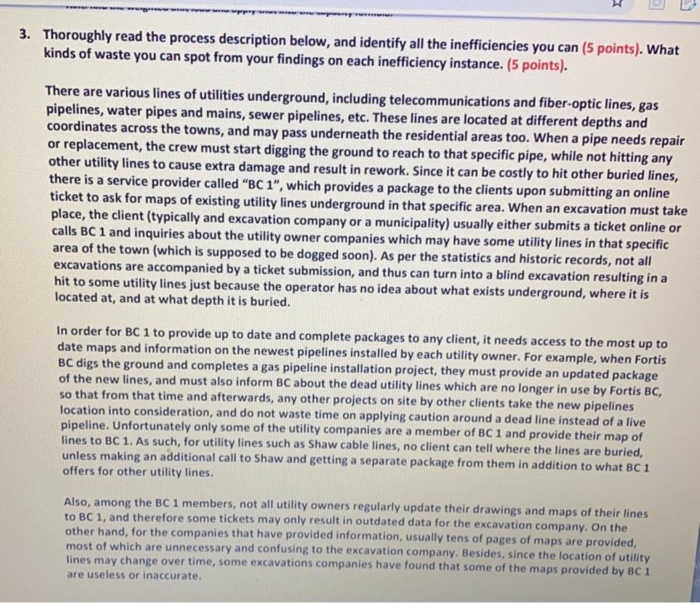
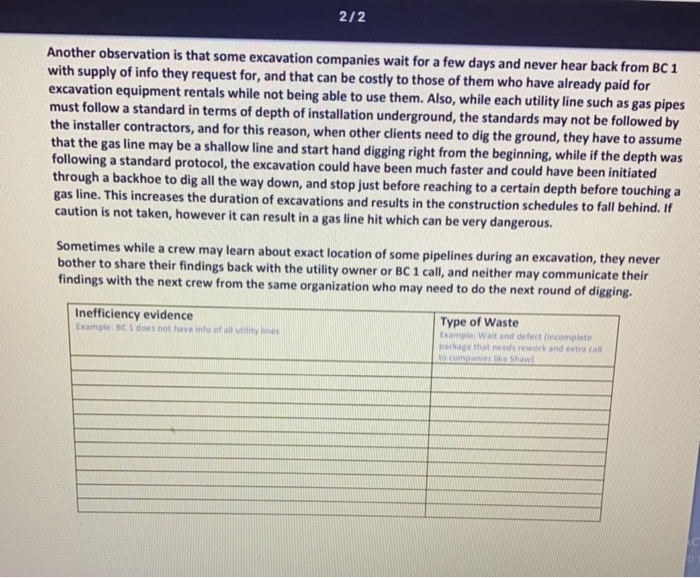
3. Thoroughly read the process description below, and identify all the inefficiencies you can (5 points). What kinds of waste you can spot from your findings on each inefficiency instance. (5 points). There are various lines of utilities underground, including telecommunications and fiber optic lines, gas pipelines, water pipes and mains, sewer pipelines, etc. These lines are located at different depths and coordinates across the towns, and may pass underneath the residential areas too. When a pipe needs repair or replacement, the crew must start digging the ground to reach to that specific pipe, while not hitting any other utility lines to cause extra damage and result in rework. Since it can be costly to hit other buried lines, there is a service provider called "BC1", which provides a package to the clients upon submitting an online ticket to ask for maps of existing utility lines underground in that specific area. When an excavation must take place, the client (typically and excavation company or a municipality) usually either submits a ticket online or calls BC 1 and inquiries about the utility owner companies which may have some utility lines in that specific area of the town (which is supposed to be dogged soon). As per the statistics and historic records, not all excavations are accompanied by a ticket submission, and thus can turn into a blind excavation resulting in a hit to some utility lines just because the operator has no idea about what exists underground, where it is located at, and at what depth it is buried. In order for BC 1 to provide up to date and complete packages to any client, it needs access to the most up to date maps and information on the newest pipelines installed by each utility owner. For example, when Fortis BC digs the ground and completes a gas pipeline installation project, they must provide an updated package of the new lines, and must also inform BC about the dead utility lines which are no longer in use by Fortis BC, so that from that time and afterwards, any other projects on site by other clients take the new pipelines location into consideration, and do not waste time on applying caution around a dead line instead of a live pipeline. Unfortunately only some of the utility companies are a member of BC 1 and provide their map of lines to BC 1. As such, for utility lines such as Shaw cable lines, no client can tell where the lines are buried, unless making an additional call to Shaw and getting a separate package from them in addition to what BC1 offers for other utility lines. Also, among the BC 1 members, not all utility owners regularly update their drawings and maps of their lines to BC 1, and therefore some tickets may only result in outdated data for the excavation company. On the other hand, for the companies that have provided information, usually tens of pages of maps are provided, most of which are unnecessary and confusing to the excavation company. Besides, since the location of utility lines may change over time, some excavations companies have found that some of the maps provided by BC 1 are useless or inaccurate, 2/2 Another observation is that some excavation companies wait for a few days and never hear back from BC 1 with supply of info they request for, and that can be costly to those of them who have already paid for excavation equipment rentals while not being able to use them. Also, while each utility line such as gas pipes must follow a standard in terms of depth of installation underground, the standards may not be followed by the installer contractors, and for this reason, when other clients need to dig the ground, they have to assume that the gas line may be a shallow line and start hand digging right from the beginning, while if the depth was following a standard protocol, the excavation could have been much faster and could have been initiated through a backhoe to dig all the way down, and stop just before reaching to a certain depth before touching a gas line. This increases the duration of excavations and results in the construction schedules to fall behind. If caution is not taken, however it can result in a gas line hit which can be very dangerous. Sometimes while a crew may learn about exact location of some pipelines during an excavation, they never bother to share their findings back with the utility owner or BC 1 call, and neither may communicate their findings with the next crew from the same organization who may need to do the next round of digging. Inefficiency evidence Example: does not have info of all utilities Type of Waste Example wait and defect incomplete that d at to comparish









 Study Help