Question: 3. Use Jupyter Notebook to answer this question. Consider a system composed of 4 stages in series with information given in the table below. The
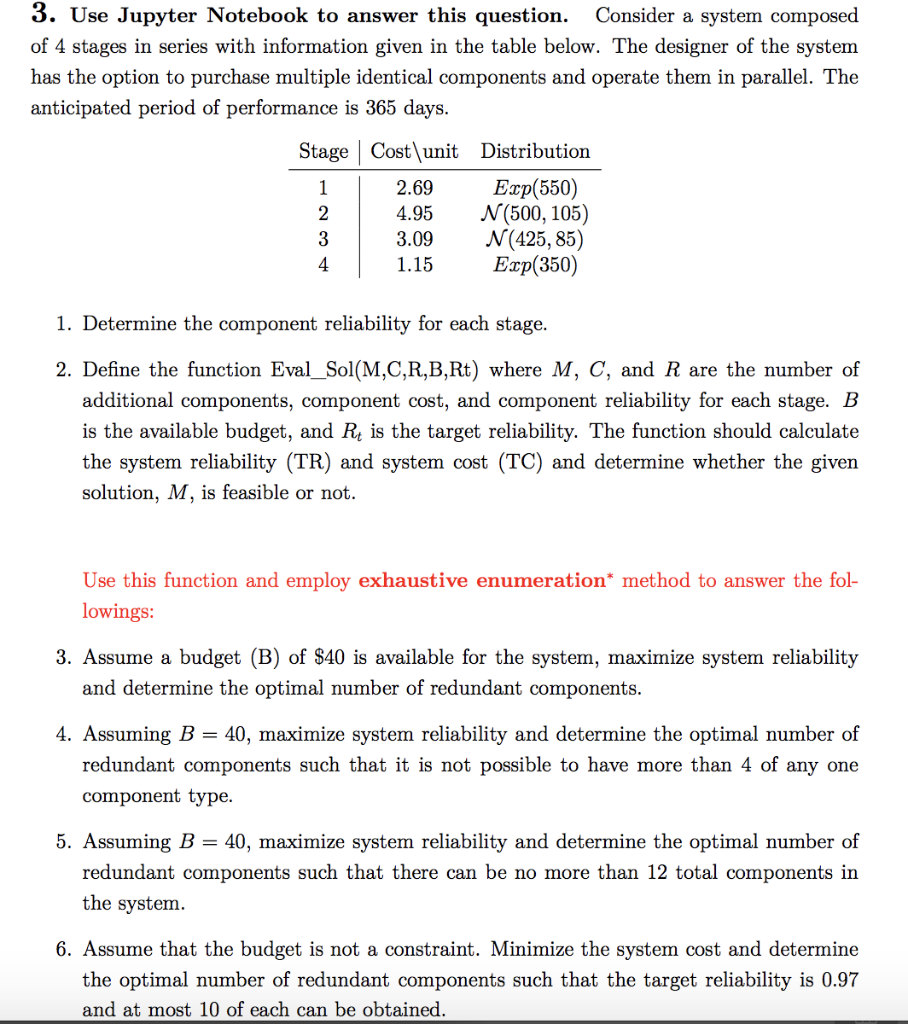
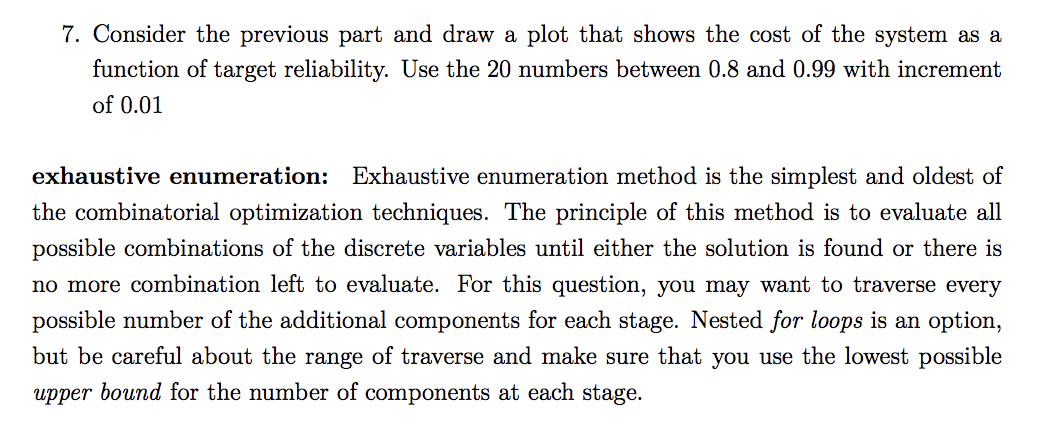
3. Use Jupyter Notebook to answer this question. Consider a system composed of 4 stages in series with information given in the table below. The designer of the system has the option to purchase multiple identical components and operate them in parallel. The anticipated period of performance is 365 days. Stage Costunit Distribution 1 2.69 Exp(550) 2 4.95 N(500, 105) 3 3.09 N(425,85) 4 1.15 Exp(350) 1. Determine the component reliability for each stage. 2. Define the function Eval_Sol(M,C,R,B,Rt) where M, C, and R are the number of additional components, component cost, and component reliability for each stage. B is the available budget, and Rt is the target reliability. The function should calculate the system reliability (TR) and system (TC) and determine whether the given solution, M, is feasible or not. Use this function and employ exhaustive enumeration* method to answer the fol- lowings: 3. Assume a budget (B) of $40 is available for the system, maximize system reliability and determine the optimal number of redundant components. 4. Assuming B = 40, maximize system reliability and determine the optimal number of redundant components such that it is not possible to have more than 4 of any one component type. 5. Assuming B = 40, maximize system reliability and determine the optimal number of redundant components such that there can be no more than 12 total components in the system. 6. Assume that the budget is not a constraint. Minimize the system cost and determine the optimal number of redundant components such that the target reliability is 0.97 and at most 10 of each can be obtained. 7. Consider the previous part and draw a plot that shows the cost of the system as a function of target reliability. Use the 20 numbers between 0.8 and 0.99 with increment of 0.01 exhaustive enumeration: Exhaustive enumeration method is the simplest and oldest of the combinatorial optimization techniques. The principle of this method is to evaluate all possible combinations of the discrete variables until either the solution is found or there is no more combination left to evaluate. For this question, you may want to traverse every possible number of the additional components for each stage. Nested for loops is an option, but be careful about the range of traverse and make sure that you use the lowest possible upper bound for the number of components at each stage. 3. Use Jupyter Notebook to answer this question. Consider a system composed of 4 stages in series with information given in the table below. The designer of the system has the option to purchase multiple identical components and operate them in parallel. The anticipated period of performance is 365 days. Stage Costunit Distribution 1 2.69 Exp(550) 2 4.95 N(500, 105) 3 3.09 N(425,85) 4 1.15 Exp(350) 1. Determine the component reliability for each stage. 2. Define the function Eval_Sol(M,C,R,B,Rt) where M, C, and R are the number of additional components, component cost, and component reliability for each stage. B is the available budget, and Rt is the target reliability. The function should calculate the system reliability (TR) and system (TC) and determine whether the given solution, M, is feasible or not. Use this function and employ exhaustive enumeration* method to answer the fol- lowings: 3. Assume a budget (B) of $40 is available for the system, maximize system reliability and determine the optimal number of redundant components. 4. Assuming B = 40, maximize system reliability and determine the optimal number of redundant components such that it is not possible to have more than 4 of any one component type. 5. Assuming B = 40, maximize system reliability and determine the optimal number of redundant components such that there can be no more than 12 total components in the system. 6. Assume that the budget is not a constraint. Minimize the system cost and determine the optimal number of redundant components such that the target reliability is 0.97 and at most 10 of each can be obtained. 7. Consider the previous part and draw a plot that shows the cost of the system as a function of target reliability. Use the 20 numbers between 0.8 and 0.99 with increment of 0.01 exhaustive enumeration: Exhaustive enumeration method is the simplest and oldest of the combinatorial optimization techniques. The principle of this method is to evaluate all possible combinations of the discrete variables until either the solution is found or there is no more combination left to evaluate. For this question, you may want to traverse every possible number of the additional components for each stage. Nested for loops is an option, but be careful about the range of traverse and make sure that you use the lowest possible upper bound for the number of components at each stage









 Study Help