







Question: 3. Using the selection rules for transitions involving electromagnetic radiation (Section 5) draw at least 12 allowed transitions on Fig. (3) involving each of the

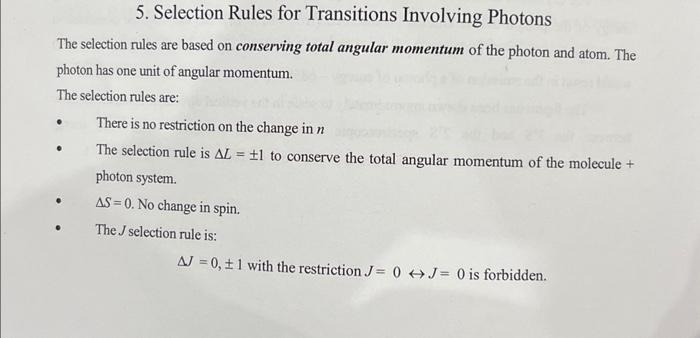
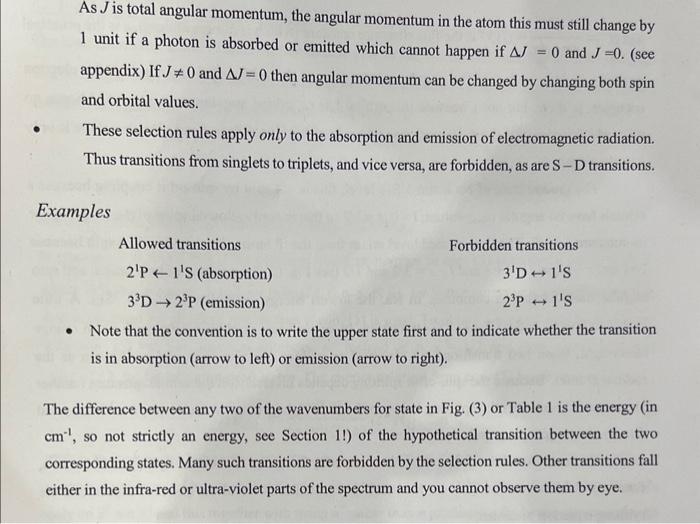
3. Using the selection rules for transitions involving electromagnetic radiation (Section 5) draw at least 12 allowed transitions on Fig. (3) involving each of the 21S,21P,31D,23S, 23P and 33D levels. (8 marks) 5. Selection Rules for Transitions Involving Photons The selection rules are based on conserving total angular momentum of the photon and atom. The photon has one unit of angular momentum. The selection rules are: - There is no restriction on the change in n - The selection rule is L=1 to conserve the total angular momentum of the molecule + photon system. - S=0. No change in spin. - The J selection rule is: J=0,1 with the restriction J=0J=0 is forbidden. As J is total angular momentum, the angular momentum in the atom this must still change by 1 unit if a photon is absorbed or emitted which cannot happen if J=0 and J=0. (see appendix) If J=0 and J=0 then angular momentum can be changed by changing both spin and orbital values. These selection rules apply only to the absorption and emission of electromagnetic radiation. Thus transitions from singlets to triplets, and vice versa, are forbidden, as are SD transitions. Examples Allowed transitions Forbidden transitions 21P11S(absorption)33D23P(emission)31D11S23P11S - Note that the convention is to write the upper state first and to indicate whether the transition is in absorption (arrow to left) or emission (arrow to right). The difference between any two of the wavenumbers for state in Fig. (3) or Table 1 is the energy (in cm1, so not strictly an energy, see Section 1!) of the hypothetical transition between the two corresponding states. Many such transitions are forbidden by the selection rules. Other transitions fall either in the infra-red or ultra-violet parts of the spectrum and you cannot observe them by eye
Step by Step Solution
There are 3 Steps involved in it

Get step-by-step solutions from verified subject matter experts
 Study Help