







Question: 3. We go back to the logistic model for population dynamics (without harvesting), but we now allow the growth rate and carrying capacity to vary
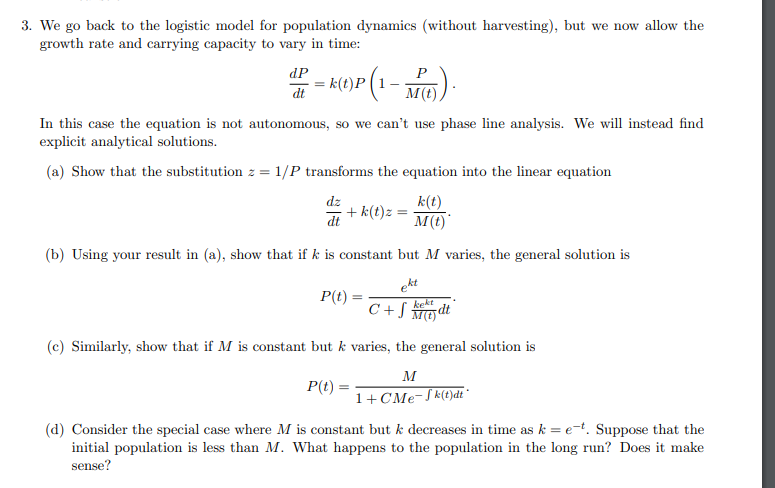
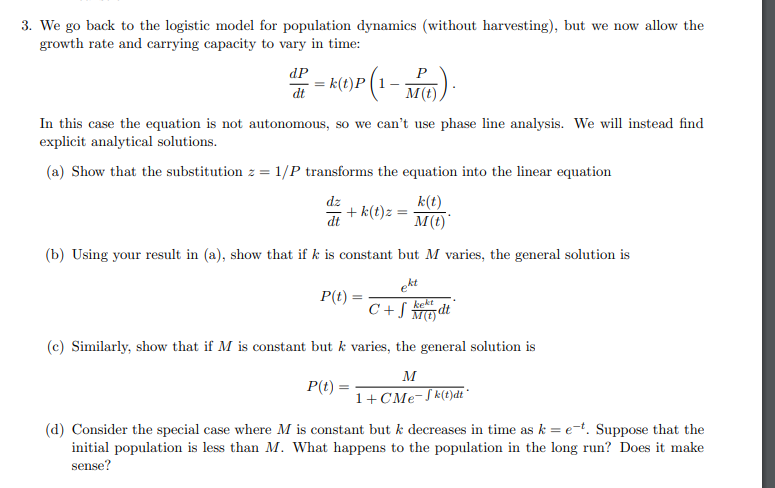
3. We go back to the logistic model for population dynamics (without harvesting), but we now allow the growth rate and carrying capacity to vary in time: dP dt = k(t)P 1 ( t ) In this case the equation is not autonomous, so we can't use phase line analysis. We will instead find explicit analytical solutions. (a) Show that the substitution z = 1/P transforms the equation into the linear equation dz k(t) + k (t)= = M(t) (b) Using your result in (a), show that if k is constant but M varies, the general solution is pht PO)= C+ Mod (c) Similarly, show that if M is constant but k varies, the general solution is M P(t) = 1+CMe-Jk(t)dt (d) Consider the special case where M is constant but & decreases in time as k = e t. Suppose that the initial population is less than M. What happens to the population in the long run? Does it make sense
Step by Step Solution
There are 3 Steps involved in it

Get step-by-step solutions from verified subject matter experts
 Study Help