







Question: 3.1 Cons Cell Representations a. Draw the list structure created by evaluating(cons'A (consB )) b. Write a pure Lisp expression that will result in this
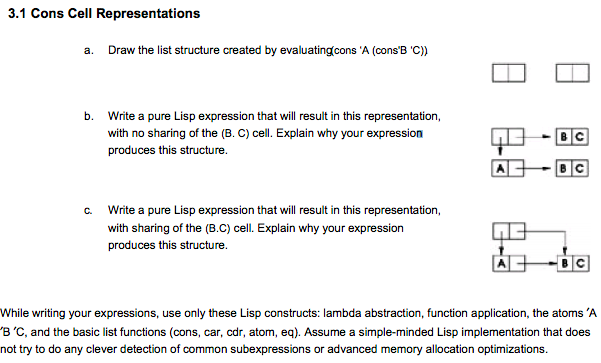
3.1 Cons Cell Representations a. Draw the list structure created by evaluating(cons'A (consB )) b. Write a pure Lisp expression that will result in this representation with no sharing of the (B. C) cell. Explain why your expression produces this structure. Write a pure Lisp expression that will result in this representation, with sharing of the (B.C) cell. Explain why your expression produces this structure. c. While writing your expressions, use only these Lisp constructs: lambda abstraction, function application, the atoms 'A B , and the basic list functions (cons, car, cdr, atom, eq). Assume a simple-minded Lisp implementation that does not try to do any clever detection of common subexpressions or advanced memory allocation optimizations. 3.1 Cons Cell Representations a. Draw the list structure created by evaluating(cons'A (consB )) b. Write a pure Lisp expression that will result in this representation with no sharing of the (B. C) cell. Explain why your expression produces this structure. Write a pure Lisp expression that will result in this representation, with sharing of the (B.C) cell. Explain why your expression produces this structure. c. While writing your expressions, use only these Lisp constructs: lambda abstraction, function application, the atoms 'A B , and the basic list functions (cons, car, cdr, atom, eq). Assume a simple-minded Lisp implementation that does not try to do any clever detection of common subexpressions or advanced memory allocation optimizations
Step by Step Solution
There are 3 Steps involved in it

Get step-by-step solutions from verified subject matter experts
 Study Help