







Question: 3.1. Two fair dice are rolled. What is the conditional probability that at least one lands on 6 given that the dice land on different
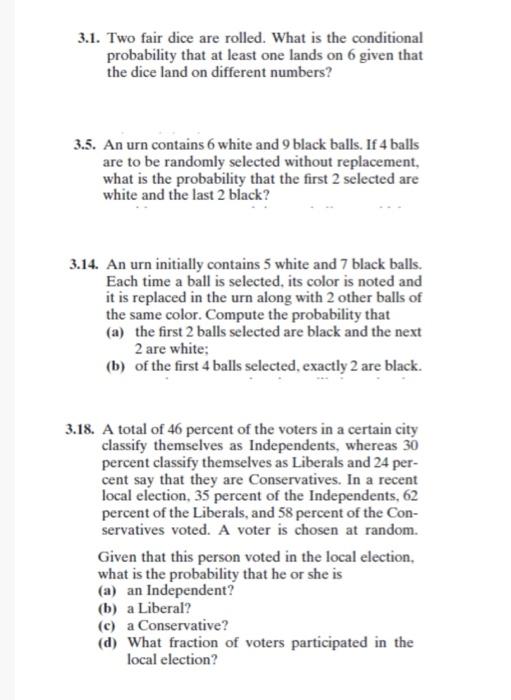
3.1. Two fair dice are rolled. What is the conditional probability that at least one lands on 6 given that the dice land on different numbers? 3.5. An urn contains 6 white and 9 black balls. If 4 balls are to be randomly selected without replacement, what is the probability that the first 2 selected are white and the last 2 black? 3.14. An urn initially contains 5 white and 7 black balls. Each time a ball is selected, its color is noted and it is replaced in the urn along with 2 other balls of the same color. Compute the probability that (a) the first 2 balls selected are black and the next 2 are white: (b) of the first 4 balls selected, exactly 2 are black. 3.18. A total of 46 percent of the voters in a certain city classify themselves as Independents, whereas 30 percent classify themselves as Liberals and 24 percent say that they are Conservatives. In a recent local election, 35 percent of the Independents, 62 percent of the Liberals, and 58 percent of the Conservatives voted. A voter is chosen at random. Given that this person voted in the local election, what is the probability that he or she is (a) an Independent? (b) a Liberal? (c) a Conservative? (d) What fraction of voters participated in the local election
Step by Step Solution
There are 3 Steps involved in it

Get step-by-step solutions from verified subject matter experts
 Study Help