



Question: 32 Chapter 1 Introduction to QUESTIONS LO2 LO 2 LO1 LO 2 LO5 1. Distinguish between internal and external expansion of a firm. 2. List
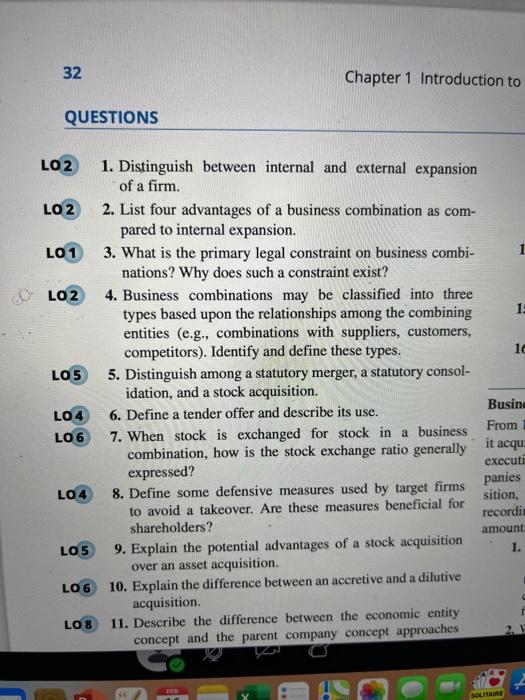
32 Chapter 1 Introduction to QUESTIONS LO2 LO 2 LO1 LO 2 LO5 1. Distinguish between internal and external expansion of a firm. 2. List four advantages of a business combination as com- pared to internal exp on. 3. What is the primary legal constraint on business combi- nations? Why does such a constraint exist? 4. Business combinations may be classified into three types based upon the relationships among the combining 12 entities (e.g., combinations with suppliers, customers, competitors). Identify and define these types. 10 5. Distinguish among a statutory merger, a statutory consol- idation, and a stock acquisition. 6. Define a tender offer and describe its use. Busin 7. When stock is exchanged for stock in a business From combination, how is the stock exchange ratio generally executi expressed? panies 8. Define some defensive measures used by target firms sition, to avoid a takeover. Are these measures beneficial for recordi shareholders? amount 9. Explain the potential advantages of a stock acquisition 1. over an asset acquisition. 10. Explain the difference between an accretive and a dilutive acquisition 11. Describe the difference between the economic entity concept and the parent company concept approaches LO 4 LO 6 it acqu LO4 LO5 LO 6 f LO 8 SOLITAIRE
Step by Step Solution
There are 3 Steps involved in it

Get step-by-step solutions from verified subject matter experts