



Question: Show that the set S and the set of all natural numbers have the same cardinality by describing an explicit one-to-one correspondence between the two
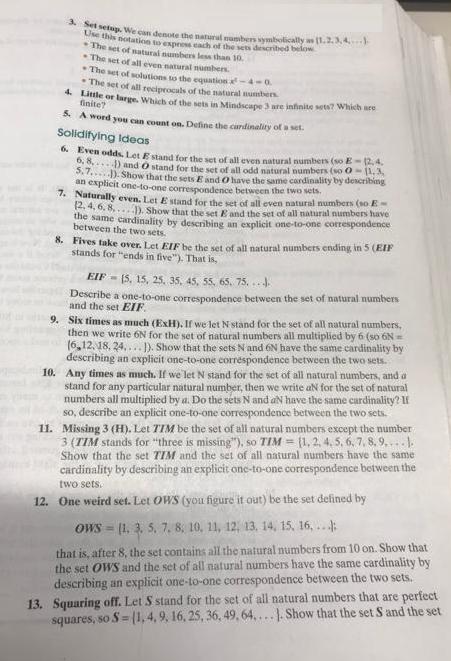 Show that the set S and the set of all natural numbers have the same cardinality by describing an explicit one-to-one correspondence between the two sets.
3. Set setup. We can denote the natural numbers symbolically as [1.2.3.4 Use this notation to express each of the sets described below The set of natural numbers less than 10. The set of all even natural numbers. The set of solutions to the equation-4-0. The set of all reciprocals of the natural numbers. 4. Little or large. Which of the sets in Mindscape 3 are infinite sets? Which are finite? & A word you can count on. Define the cardinality of a set. Solidifying Ideas 6. Even odds. Let E stand for the set of all even natural numbers (so E-12.4. 6,8,) and O stand for the set of all odd natural numbers (so 0-11.3 5.7.....1). Show that the sets E and O have the same cardinality by describing an explicit one-to-one correspondence between the two sets. 7. Naturally even. Let E stand for the set of all even natural numbers (so E- (2,4,6,8,...). Show that the set E and the set of all natural numbers have the same cardinality by describing an explicit one-to-one correspondence between the two sets. 8. Fives take over. Let EIF be the set of all natural numbers ending in 5 (EIF stands for "ends in five"). That is, EIF (5, 15, 25, 35, 45, 55, 65, 75.... 4 Describe a one-to-one correspondence between the set of natural numbers and the set EIF. 9. Six times as much (ExH). If we let N stand for the set of all natural numbers, then we write 6N for the set of natural numbers all multiplied by 6 (so 6N (6,12,18,24,...). Show that the sets N and 6N have the same cardinality by describing an explicit one-to-one correspondence between the two sets. 10. Any times as much. If we let N stand for the set of all natural numbers, and a stand for any particular natural number, then we write aN for the set of natural numbers all multiplied by a. Do the sets N and aN have the same cardinality? If so, describe an explicit one-to-one correspondence between the two sets. 11. Missing 3 (H). Let TIM be the set of all natural numbers except the number 3 (TIM stands for "three is missing"), so TIM = (1, 2, 4, 5, 6, 7, 8, 9, 1. Show that the set TIM and the set of all natural numbers have the same cardinality by describing an explicit one-to-one correspondence between the two sets. 12. One weird set. Let OWS (you figure it out) be the set defined by Ows (1, 3, 5, 7, 8, 10, 11, 12, 13, 14, 15, 16, that is, after 8, the set contains all the natural numbers from 10 on. Show that the set OWS and the set of all natural numbers have the same cardinality by describing an explicit one-to-one correspondence between the two sets. 13. Squaring off. Let S stand for the set of all natural numbers that are perfect squares, so S= (1,4, 9, 16, 25, 36, 49, 64..... Show that the set S and the set
Step by Step Solution
3.55 Rating (183 Votes )
There are 3 Steps involved in it
1 Cardinality of a Set The cardinality of a set is the number of elements in the set It is a measure of the size of the set and is denoted by the symbol S where S is the set For example if S is the se... View full answer

Get step-by-step solutions from verified subject matter experts