Question: Identify the correct steps involved in proving that if A, B, and Care sets such that IAI S IB) and IBI S ICI, then IAl
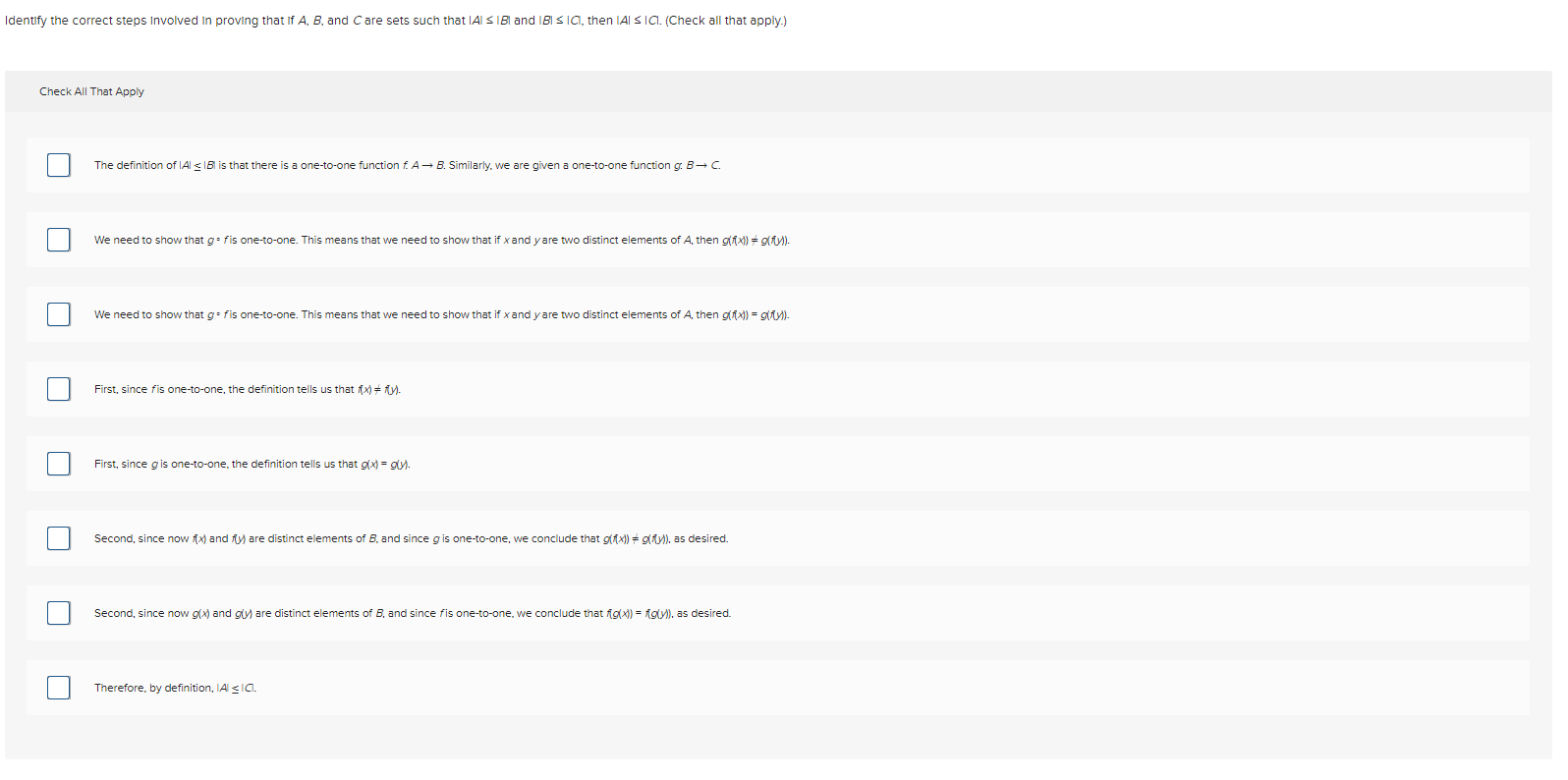
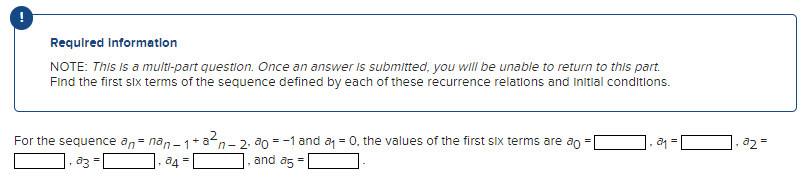
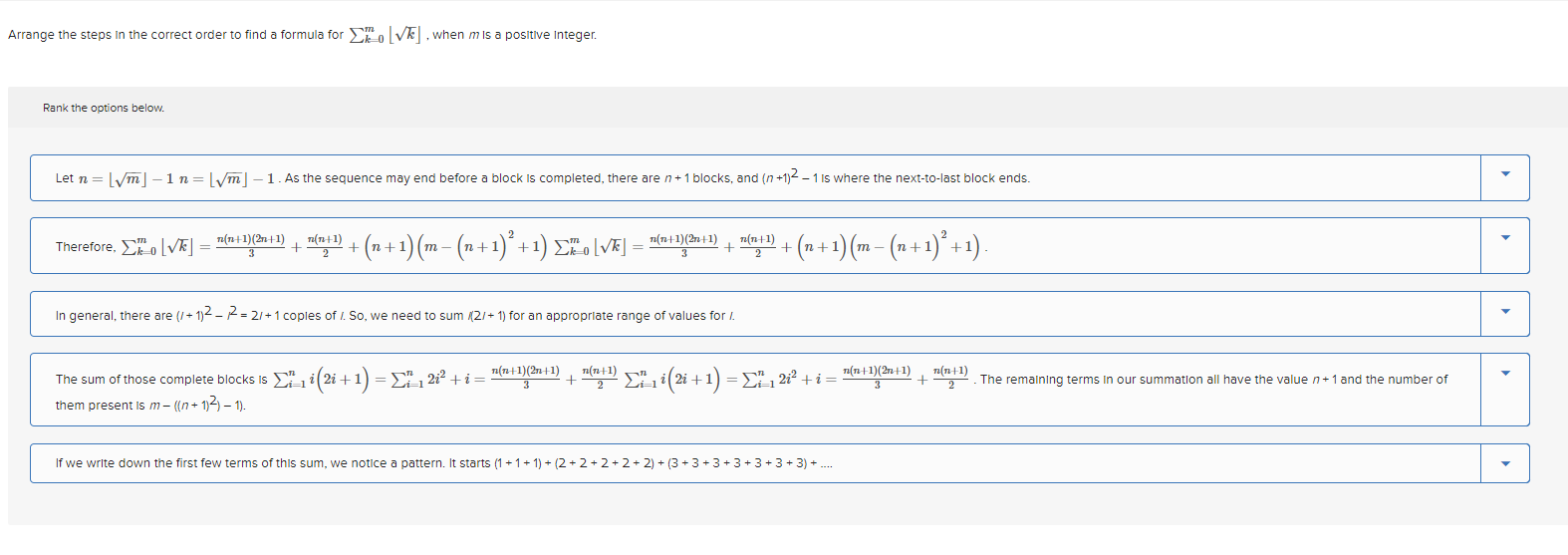
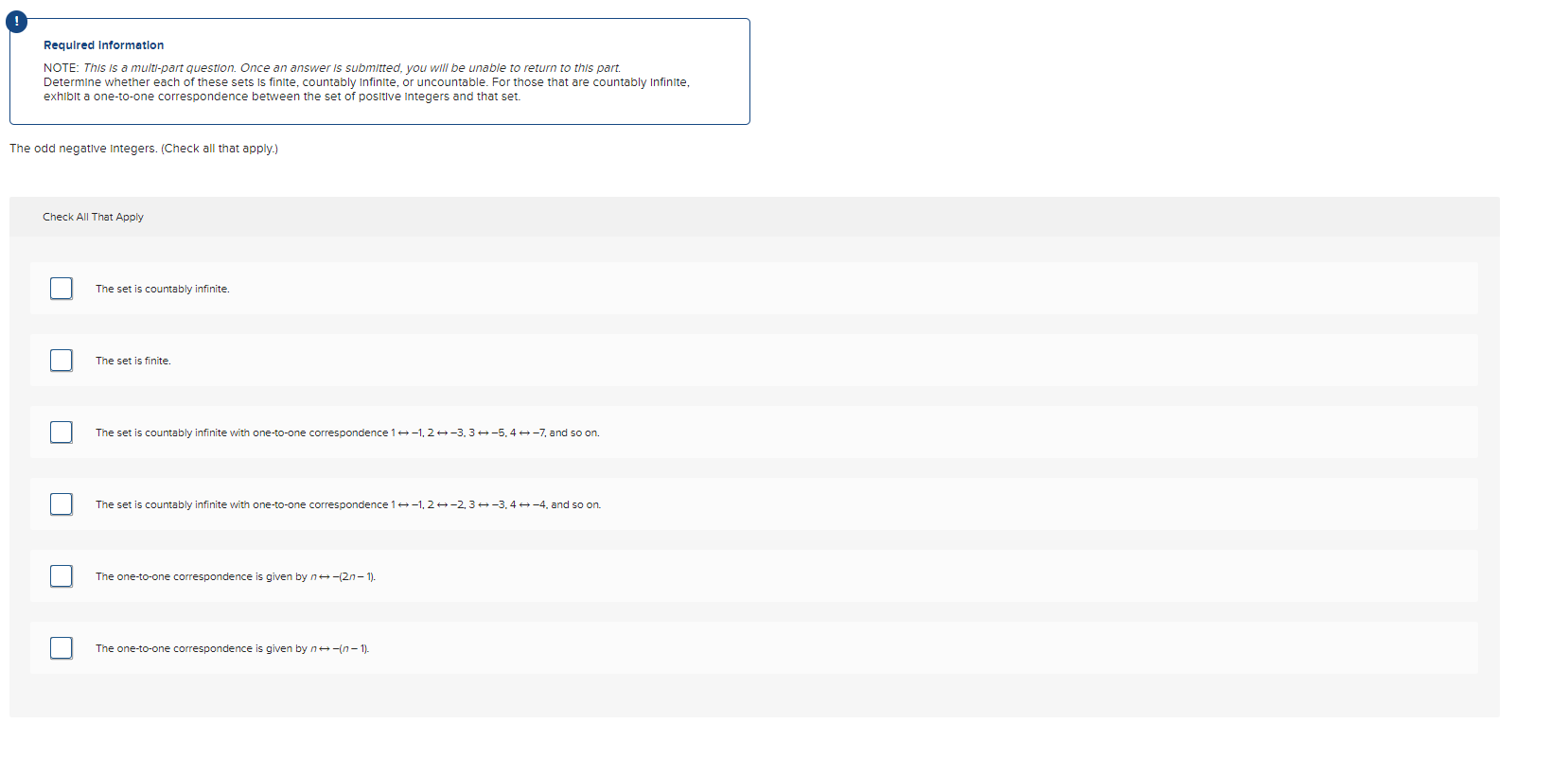
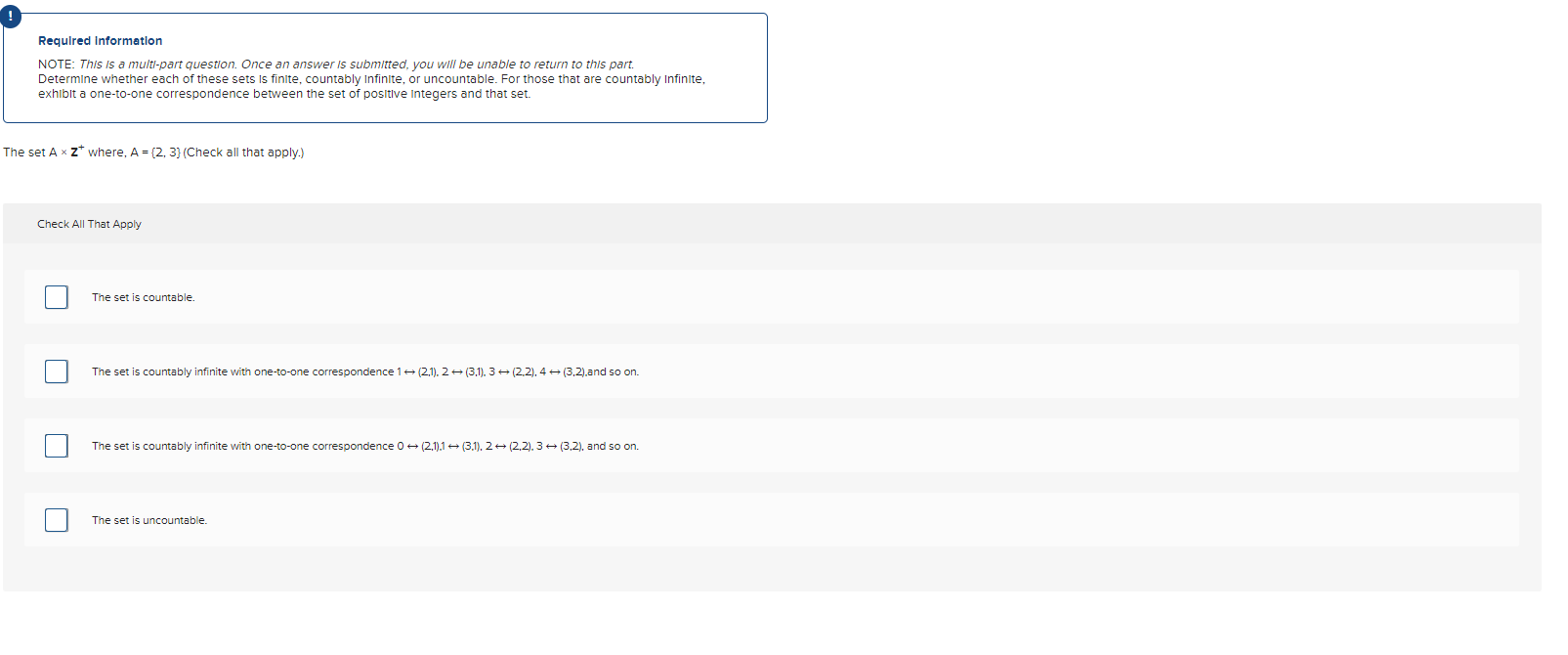
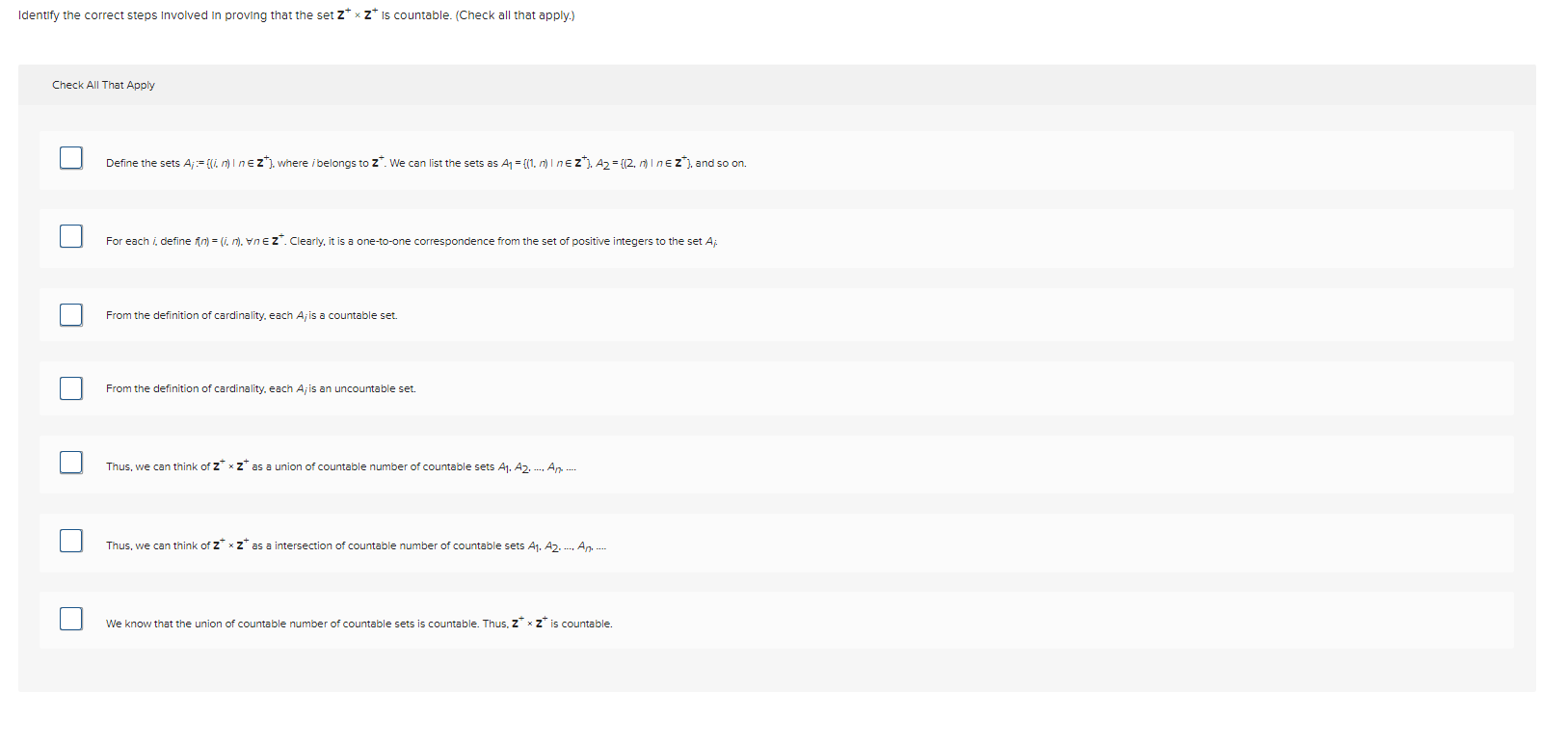
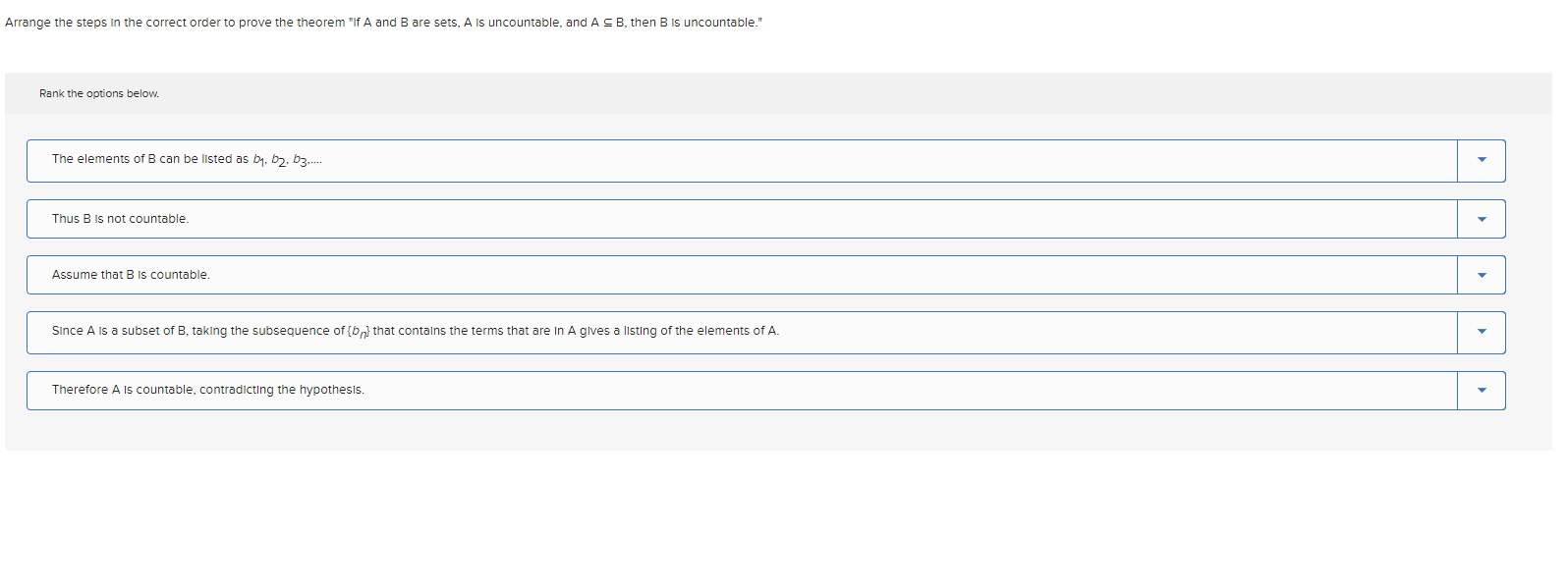
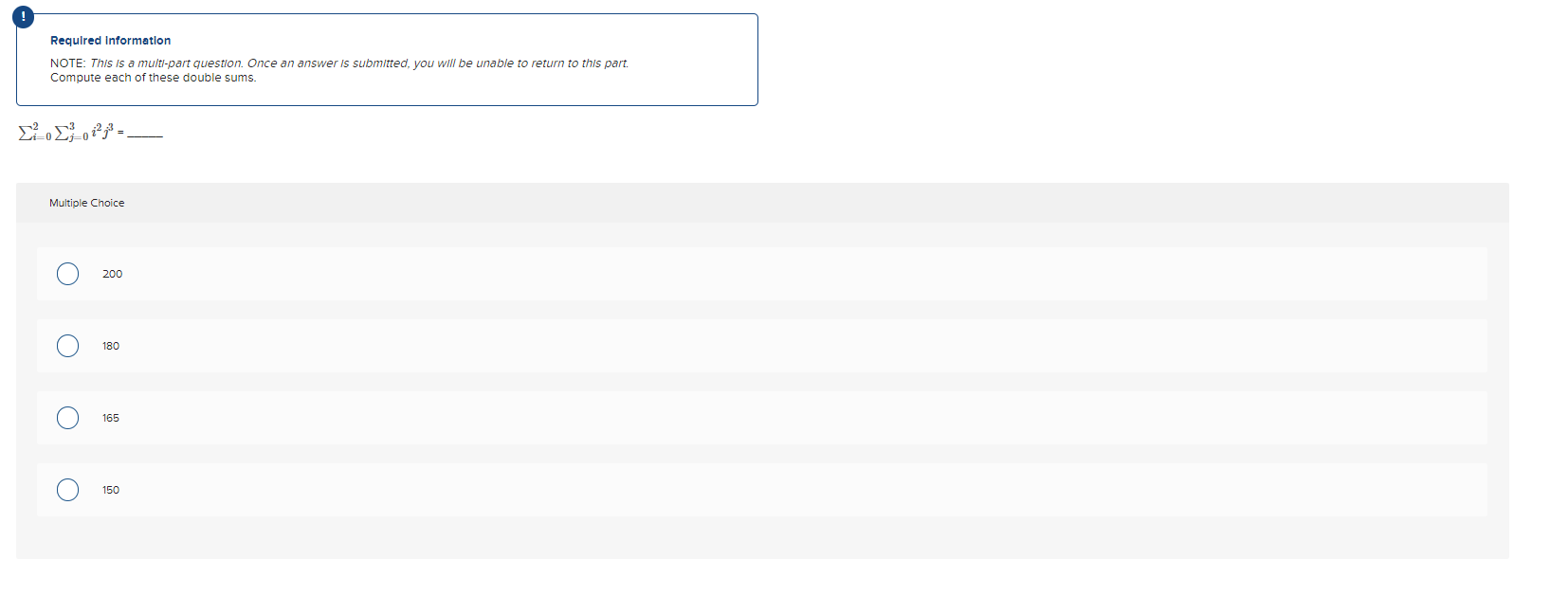
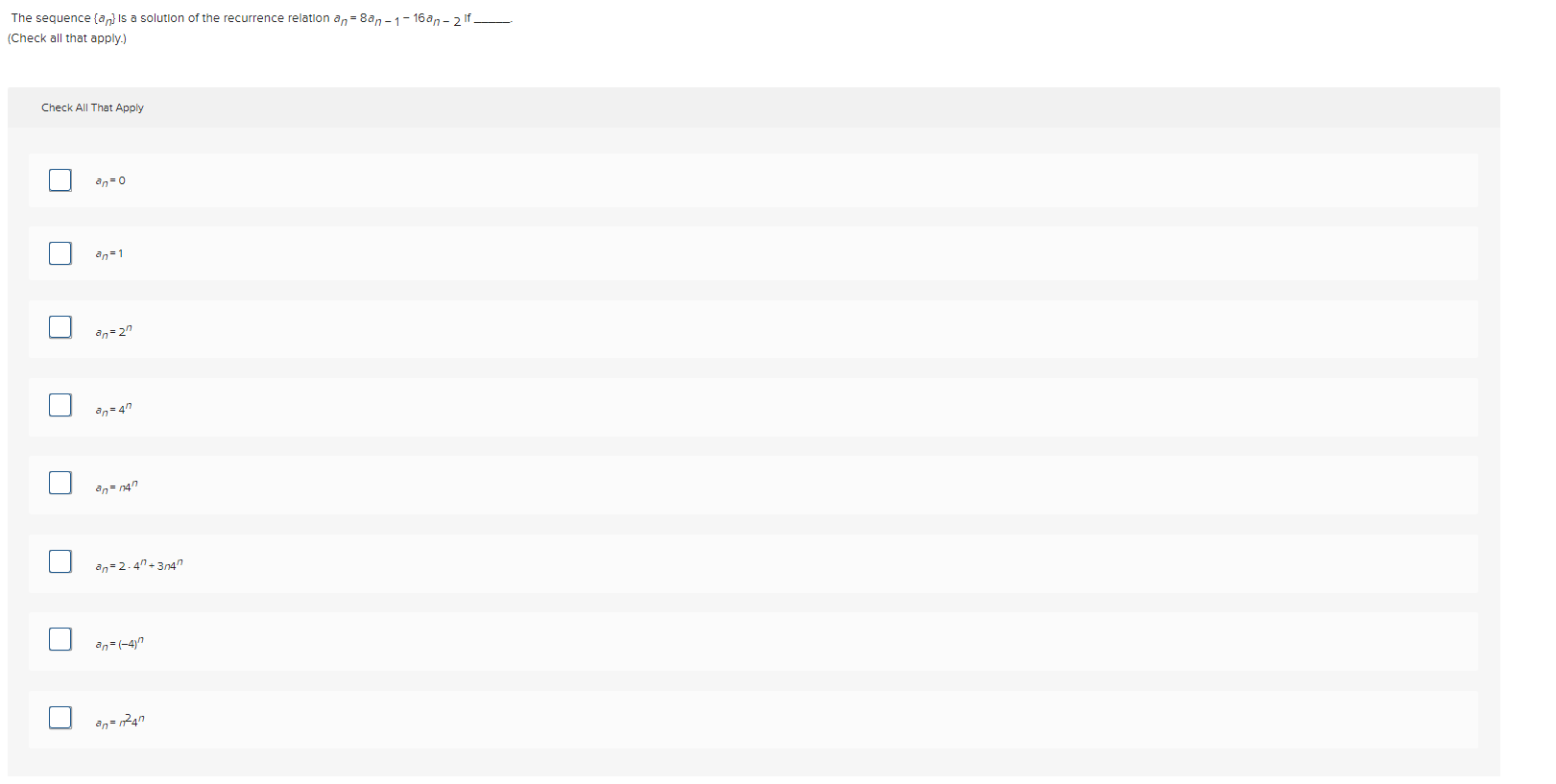
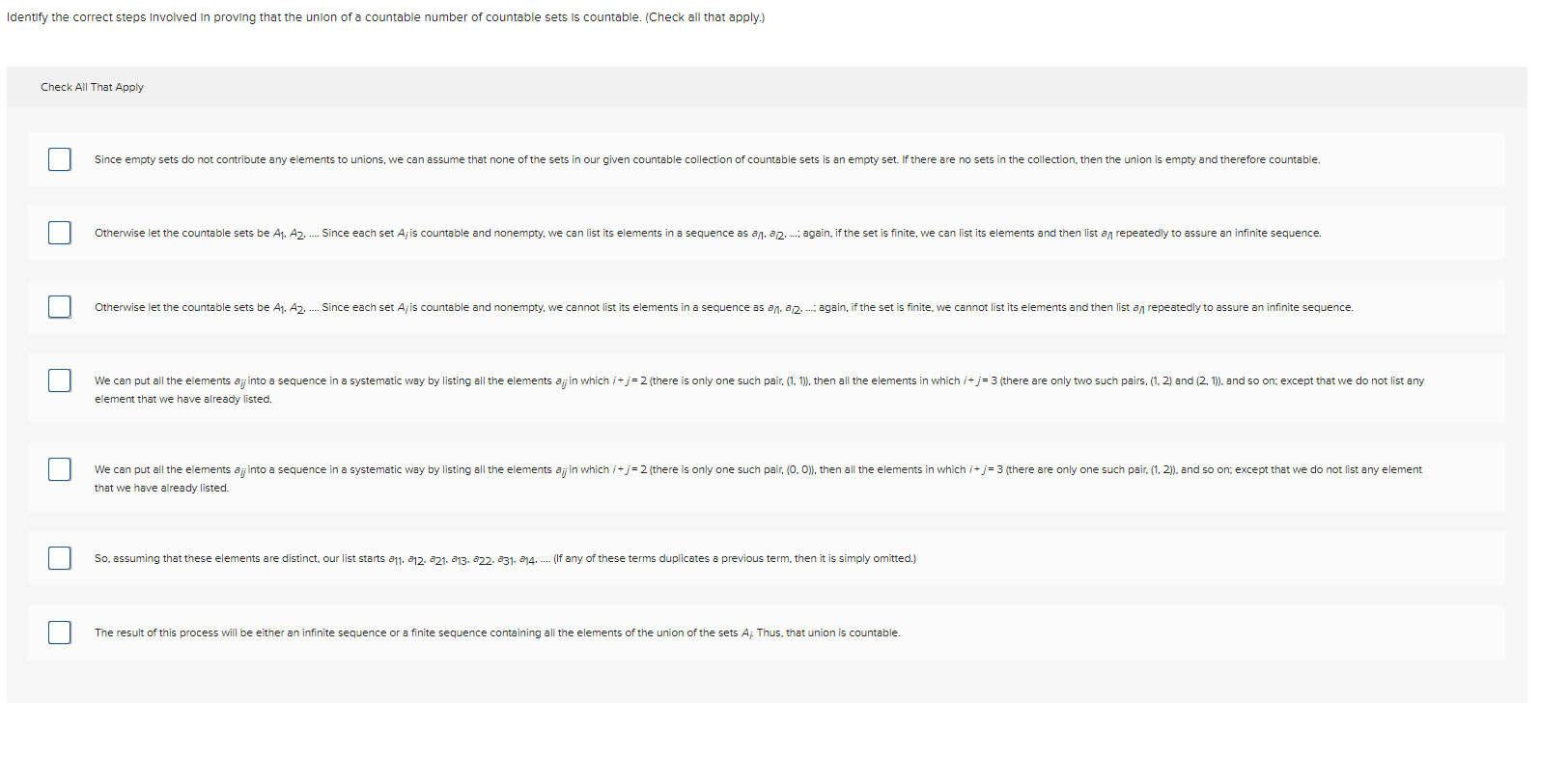
Identify the correct steps involved in proving that if A, B, and Care sets such that IAI S IB) and IBI S ICI, then IAl S ICI. (Check all that apply.) Check All That Apply The definition of IAl $ 181 is that there is a one-to-one function f A - B. Similarly. we are given a one-to-one function g. B - C. We need to show that g = fis one-to-one. This means that we need to show that if x and y are two distinct elements of A, then g(fix)) # 9(ty). We need to show that g : fis one-to-one. This means that we need to show that if x and y are two distinct elements of A, then g(fx)) = g(fyl). First, since fis one-to-one, the definition tells us that (x) # AM). First, since g is one-to-one, the definition tells us that g(x) = g(). Second, since now fix) and fly) are distinct elements of 8, and since g is one-to-one, we conclude that g(fx]) # 9(/{y), as desired. Second, since now g(x) and g(y) are distinct elements of 8, and since fis one-to-one. we conclude that fig(x) = 19()). as desired. Therefore, by definition, IAl s IC.Required Information NOTE: This is a multi-part question. Once an answer is submitted, you will be unable to return to this part. Find the first six terms of the sequence defined by each of these recurrence relations and Initial conditions. For the sequence an = nap _ + a- "n- 2, do = -1 and a = 0, the values of the first six terms are ag , a2 = , 83 = 84 and as =NOTE: This is a multi-part question. Once an answer is submitted, you will be unable to return to this part. Find the first six terms of the sequence defined by each of these recurrence relations and Initial conditions. For the sequence an = an -1- an -2+ an- 3. ag =1, a1 =1, and ay = 2, the values of the first six terms are an = , 82 = , 83 = , 34= , and as =Arrange the steps in the correct order to find a formula for _ko [v/] . when m is a positive Integer. Rank the options below. Let n = [vm] -1 n = [vm] - 1. As the sequence may end before a block is completed, there are / + 1 blocks, and (n +1)- - 1 is where the next-to-last block ends. Therefore. EF . [VK] = 201() , Roll + (n + 1)(m -(n+1) +1) >F. [Vx] - )(:) , 2(1). 2 2 + (12 + 1 ) (m - (n + 1 ) + 1 ) In general, there are (/+ 1)2 - P = 2/+ 1 copies of /. So, we need to sum (2/+ 1) for an appropriate range of values for 1. The sum of those complete blocks is _ 1 2 (2: + 1) = >? , 212 ( 1 - 2(:1)(2n+1) _ n(n+1) 2. The remaining terms In our summation all have the value n + 1 and the number of them present is m - ((n + 1)2) - 1). If we write down the first few terms of this sum, we notice a pattern. It starts (1 + 1 +1) + (2 +2 + 2+ 2 + 2) + (3+3 +3+3 + 3 + 3 + 3) + ....Required Information NOTE: This is a multi-part question. Once an answer is submitted, you will be unable to return to this part. Determine whether each of these sets is finite, countably Infinite, or uncountable. For those that are countably Infinite, exhibit a one-to-one correspondence between the set of positive Integers and that set. The odd negative Integers. (Check all that apply.) Check All That Apply The set is countably infinite. The set is finite. The set is countably infinite with one-to-one correspondence 1 + -1, 2 + -3, 3 + -5,4 +-7, and so on. The set is countably infinite with one-to-one correspondence 1 + -1, 2 + -2, 3 + -3.4 + -4, and so on. The one-to-one correspondence is given by n - -(2n - 1). The one-to-one correspondence is given by n -(n - 1).Required Information NOTE: This is a multi-part question. Once an answer is submitted, you will be unable to return to this part. Determine whether each of these sets is finite, countably Infinite, or uncountable. For those that are countably Infinite, exhibit a one-to-one correspondence between the set of positive integers and that set. The set A x Z* where, A = (2, 3) (Check all that apply.) Check All That Apply The set is countable. The set is countably infinite with one-to-one correspondence 1 + (2.1). 2 + (3.1). 3 + (2.2). 4 + (3,2).and so on. The set is countably infinite with one-to-one correspondence 0 + (2.1).1 ++ (3.1). 2 + (2,2). 3 + (3,2), and so on. The set is uncountable.Identify the correct steps involved in proving that the set Z" x Z" is countable. (Check all that apply.) Check All That Apply Define the sets A;:= [(i. n) I ne Z*). where / belongs to Z". We can list the sets as A1 = {(1. m) I ne Z"). A2 = {(2, /) I ne Z"), and so on. For each i. define fin) = (i. m). vn E Z". Clearly, it is a one-to-one correspondence from the set of positive integers to the set Aj From the definition of cardinality. each A; is a countable set. From the definition of cardinality. each A/is an uncountable set. Thus, we can think of Z x Z* as a union of countable number of countable sets A1. Az. .... An .. Thus, we can think of Z" x Z* as a intersection of countable number of countable sets A1. Az. .... An. .. We know that the union of countable number of countable sets is countable. Thus, Z" x Z" is countable.Arrange the steps In the correct order to prove the theorem "If A and B are sets, A is uncountable, and A S B, then B is uncountable." Rank the options below. The elements of B can be listed as by. by, b3..... Thus B is not countable. Assume that B Is countable. Since A is a subset of B, taking the subsequence of {by) that contains the terms that are In A gives a listing of the elements of A. Therefore A Is countable, contradicting the hypothesis.Required Information NOTE: This is a multi-part question. Once an answer is submitted, you will be unable to return to this part. Compute each of these double sums. Multiple Choice O 200 O 180 O 165 O 150The sequence {an} is a solution of the recurrence relation an = 8an - 1 - 16an - 2 If. (Check all that apply.) Check All That Apply an = 0 an = 1 an = 20 an = 47 an = 047 an = 2. 47 + 3n47 an= (-4)7 an = 1240Identify the correct steps involved in proving that the union of a countable number of countable sets is countable. (Check all that apply.) Check All That Apply Since empty sets do not contribute any elements to unions, we can assume that none of the sets in our given countable collection of countable sets is an empty set. If there are no sets in the collection, then the union is empty and therefore countable. Otherwise let the countable sets be Aj. Az. .. Since each set Aj is countable and nonempty, we can list its elements in a sequence as an. a,2. ...; again, if the set is finite, we can list its elements and then list an repeatedly to assure an infinite sequence. Otherwise let the countable sets be A1, A2. .. Since each set A; is countable and nonempty, we cannot list its elements in a sequence as an. a/2. ..; again, if the set is finite. we cannot list its elements and then list an repeatedly to assure an infinite sequence. We can put all the elements ay into a sequence in a systematic way by listing all the elements ay in which /+ /= 2 (there is only one such pair, (1. 1). then all the elements in which i+ )= 3 (there are only two such pairs. (1. 2) and (2, 1). and so on; except that we do not list any element that we have already listed. We can put all the elements ay into a sequence in a systematic way by listing all the elements ay in which /+/= 2 (there is only one such pair, (0. 0). then all the elements in which i+ j= 3 (there are only one such pair. (1, 2)). and so on: except that we do not list any element that we have already listed. So. assuming that these elements are distinct. our list starts a11. a12. a21. 813. a22. 831. a14. .... (If any of these terms duplicates a previous term, then it is simply omitted.) The result of this process will be either an infinite sequence or a finite sequence containing all the elements of the union of the sets A; Thus. that union is countable
Step by Step Solution
There are 3 Steps involved in it
1 Expert Approved Answer
Step: 1 Unlock
Question Has Been Solved by an Expert!
Get step-by-step solutions from verified subject matter experts
Step: 2 Unlock
Step: 3 Unlock
Students Have Also Explored These Related Mathematics Questions!










 Study Help