







Question: 32) Determine whether the given relation is an equivalence relation on the set. Describe the partition arising from the equivalence relation. (x1,y1)R(x2, y2) in
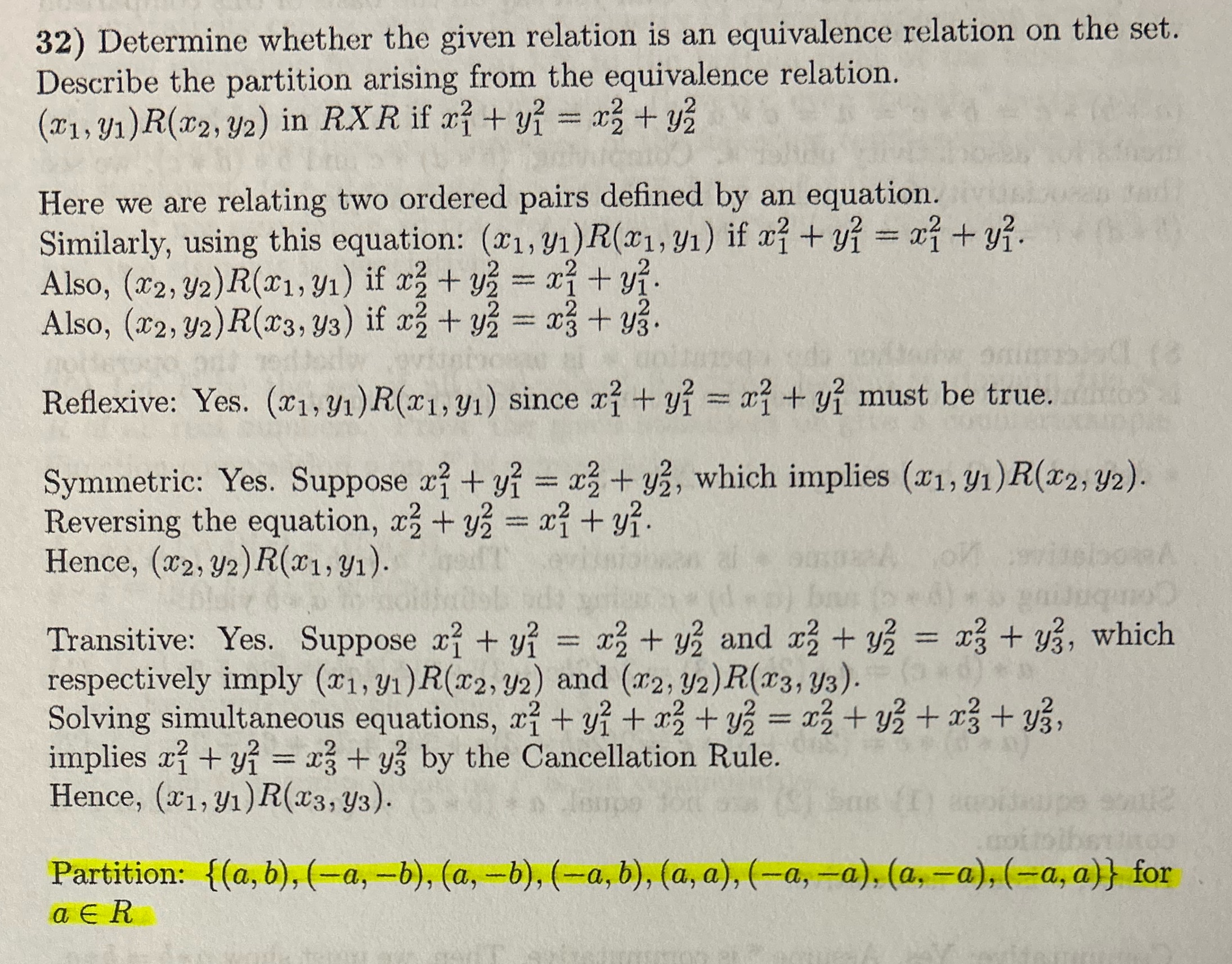
32) Determine whether the given relation is an equivalence relation on the set. Describe the partition arising from the equivalence relation. (x1,y1)R(x2, y2) in RXR if x + y = x + y Here we are relating two ordered pairs defined by an equation. Similarly, using this equation: (x1,y1)R(x1,y1) if x + y = x + y. Also, (x2, y2) R(x1,y1) if x Also, (x2, y2) R(x3, y3) if x + y = x + y. + y = x + y. Reflexive: Yes. (x1,y1) R(x1,y1) since x + y = x + y must be true. Symmetric: Yes. Suppose x + y = x + y2, which implies (x1,y1)R(x2, y2). Reversing the equation, x + y = x + y. Hence, (x2, y2) R(x1,y1). (3 Transitive: Yes. Suppose x + y = x + y and x + y = x + y, which respectively imply (x1,y1)R(x2, y2) and (x2, y2) R(x3, Y3). (6) Solving simultaneous equations, x + y + x + y = x+y+x+y, implies x + y = x + y by the Cancellation Rule. Hence, (x1,y1) R(x3, Y3). Partition: {(a, b), (-a, b), (a, b), (-a, b), (a, a), (-a, -a), (a, -a), (-a, a)} for a R
Step by Step Solution
There are 3 Steps involved in it

Get step-by-step solutions from verified subject matter experts
 Study Help