







Question: 3.2 General Results for Linear Equations The linear equation of the nth order is Pn(t)y(t + n) + + po(t)y(t) = r(t), (3.4) where
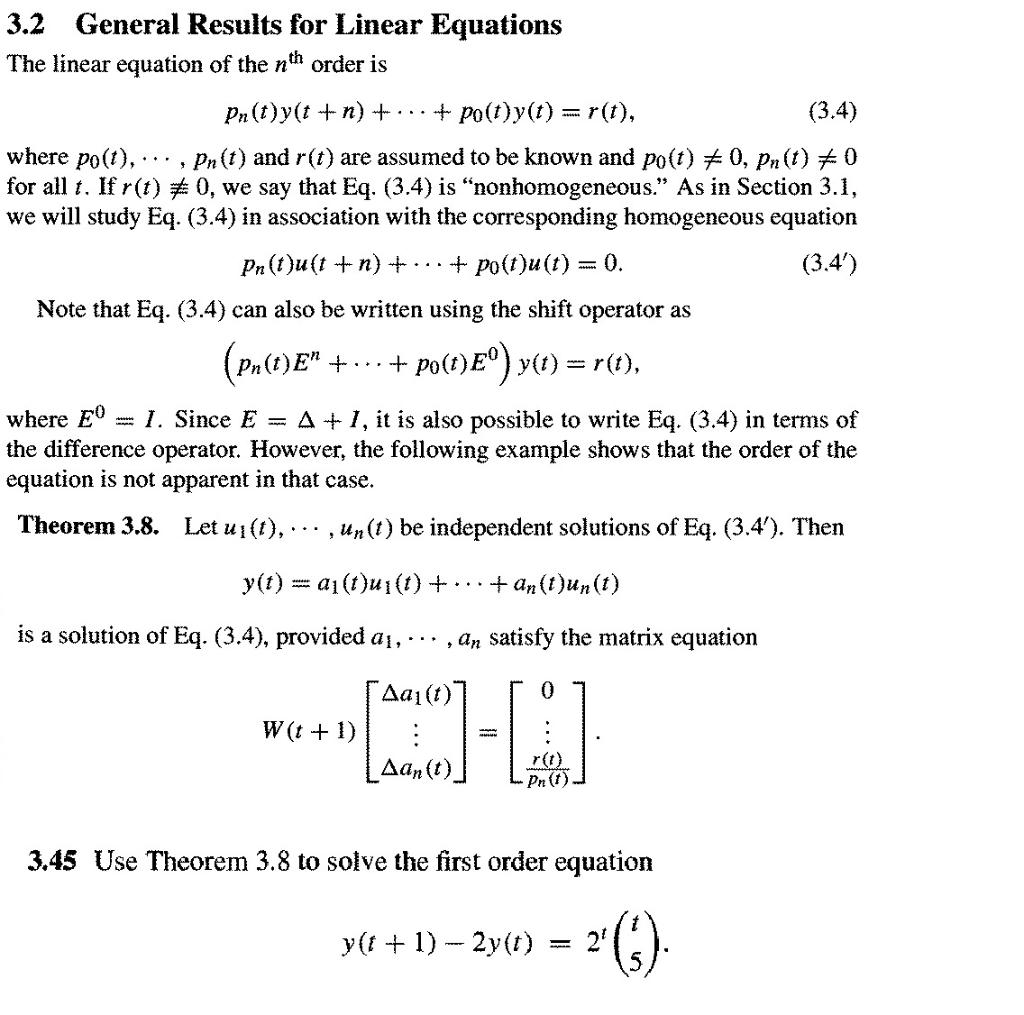
3.2 General Results for Linear Equations The linear equation of the nth order is Pn(t)y(t + n) + + po(t)y(t) = r(t), (3.4) where po(t),..., Pn (t) and r(t) are assumed to be known and po(t) = 0, Pn(t) 0 for all t. If r(t) # 0, we say that Eq. (3.4) is "nonhomogeneous." As in Section 3.1, we will study Eq. (3.4) in association with the corresponding homogeneous equation Pn(t)u(t + n) + + po(t)u(t) = 0. (3.4') Note that Eq. (3.4) can also be written using the shift operator as (Pn(1) E" + + Po(t)E) y(t) = r(t), where EO 1. Since E = A + 1, it is also possible to write Eq. (3.4) in terms of the difference operator. However, the following example shows that the order of the equation is not apparent in that case. Theorem 3.8. Let ui(t),.. un (t) be independent solutions of Eq. (3.4'). Then y(t) = a(t)u(t) + + an(t)un(t) is a solution of Eq. (3.4), provided a,, an satisfy the matrix equation Aai(t)" W(t + 1) Aan(t) 0 3.45 Use Theorem 3.8 to solve the first order equation y(t+1) - 2y(t) (3). 2
Step by Step Solution
3.47 Rating (163 Votes )
There are 3 Steps involved in it
SOLUTION To solve the firstorder equation yt1 2yt 2t binomt5 using Theorem 38 we need to find the independent solutions of the corresponding homogeneo... View full answer

Get step-by-step solutions from verified subject matter experts
 Study Help