







Question: 32 [Note: This is a problem that applies known concepts to a different situation and may feel difficult to most students. If you are unsure,
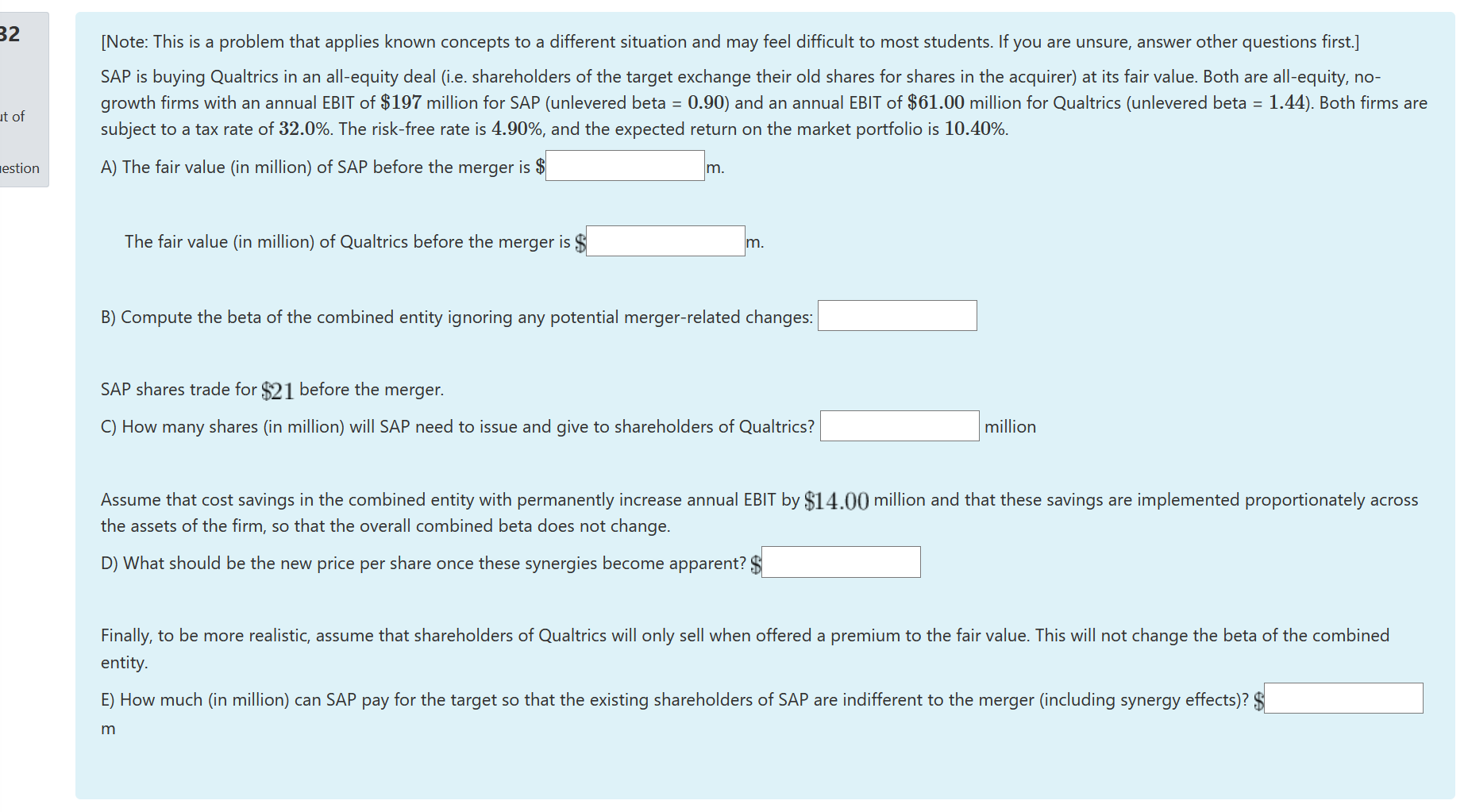
32 [Note: This is a problem that applies known concepts to a different situation and may feel difficult to most students. If you are unsure, answer other questions first.] SAP is buying Qualtrics in an all-equity deal (i.e. shareholders of the target exchange their old shares for shares in the acquirer) at its fair value. Both are all-equity, no- growth firms with an annual EBIT of $197 million for SAP (unlevered beta = 0.90) and an annual EBIT of $61.00 million for Qualtrics (unlevered beta = 1.44). Both firms are subject to a tax rate of 32.0%. The risk-free rate is 4.90%, and the expected return on the market portfolio is 10.40%. ut of estion A) The fair value (in million) of SAP before the merger is $ m. The fair value (in million) of Qualtrics before the merger is m. B) Compute the beta of the combined entity ignoring any potential merger-related changes: SAP shares trade for $21 before the merger. C) How many shares (in million) will SAP need to issue and give to shareholders of Qualtrics? million Assume that cost savings in the combined entity with permanently increase annual EBIT by $14.00 million and that these savings are implemented proportionately across the assets of the firm, so that the overall combined beta does not change. D) What should be the new price per share once these synergies become apparent? $ Finally, to be more realistic, assume that shareholders of Qualtrics will only sell when offered a premium to the fair value. This will not change the beta of the combined entity. E) How much (in million) can SAP pay for the target so that the existing shareholders of SAP are indifferent to the merger (including synergy effects)? $ m 32 [Note: This is a problem that applies known concepts to a different situation and may feel difficult to most students. If you are unsure, answer other questions first.] SAP is buying Qualtrics in an all-equity deal (i.e. shareholders of the target exchange their old shares for shares in the acquirer) at its fair value. Both are all-equity, no- growth firms with an annual EBIT of $197 million for SAP (unlevered beta = 0.90) and an annual EBIT of $61.00 million for Qualtrics (unlevered beta = 1.44). Both firms are subject to a tax rate of 32.0%. The risk-free rate is 4.90%, and the expected return on the market portfolio is 10.40%. ut of estion A) The fair value (in million) of SAP before the merger is $ m. The fair value (in million) of Qualtrics before the merger is m. B) Compute the beta of the combined entity ignoring any potential merger-related changes: SAP shares trade for $21 before the merger. C) How many shares (in million) will SAP need to issue and give to shareholders of Qualtrics? million Assume that cost savings in the combined entity with permanently increase annual EBIT by $14.00 million and that these savings are implemented proportionately across the assets of the firm, so that the overall combined beta does not change. D) What should be the new price per share once these synergies become apparent? $ Finally, to be more realistic, assume that shareholders of Qualtrics will only sell when offered a premium to the fair value. This will not change the beta of the combined entity. E) How much (in million) can SAP pay for the target so that the existing shareholders of SAP are indifferent to the merger (including synergy effects)? $ m
Step by Step Solution
There are 3 Steps involved in it

Get step-by-step solutions from verified subject matter experts
 Study Help