Question: 3-4. This exercise considers variations on the assignment problem introduced in Section 3.3. (a) Try reordering the list of members of DEST in the data
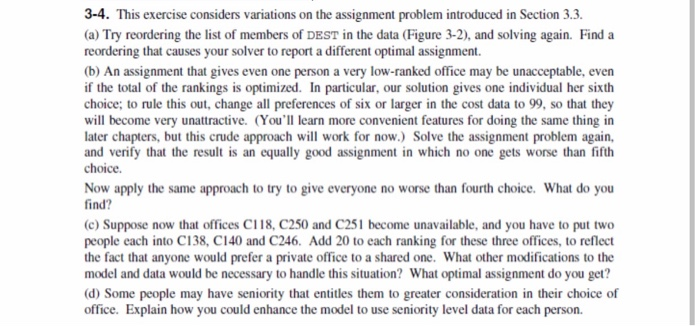
3-4. This exercise considers variations on the assignment problem introduced in Section 3.3. (a) Try reordering the list of members of DEST in the data (Figure 3-2), and solving again. Find a reordering that causes your solver to report a different optimal assignment. (b) An assignment that gives even one person a very low-ranked office may be unacceptable, even if the total of the rankings is optimized. In particular, our solution gives one individual her sixth choice; to rule this out, change all preferences of six or larger in the cost data to 99, so that they will become very unattractive. (You'll learn more convenient features for doing the same thing in later chapters, but this crude approach will work for now.) Solve the assignment problem again, and verify that the result is an equally good assignment in which no one gets worse than fifth choice. Now apply the same approach to try to give everyone no worse than fourth choice. What do you find? (e) Suppose now that offices C118, C250 and C251 become unavailable, and you have to put two people each into C138, C140 and C246. Add 20 to each ranking for these three offices, to reflect the fact that anyone would prefer a private office to a shared one. What other modifications to the model and data would be necessary to handle this situation? What optimal assignment do you get? (d) Some people may have seniority that entitles them to greater consideration in their choice of office. Explain how you could enhance the model to use seniority level data for each person. 3-4. This exercise considers variations on the assignment problem introduced in Section 3.3. (a) Try reordering the list of members of DEST in the data (Figure 3-2), and solving again. Find a reordering that causes your solver to report a different optimal assignment. (b) An assignment that gives even one person a very low-ranked office may be unacceptable, even if the total of the rankings is optimized. In particular, our solution gives one individual her sixth choice; to rule this out, change all preferences of six or larger in the cost data to 99, so that they will become very unattractive. (You'll learn more convenient features for doing the same thing in later chapters, but this crude approach will work for now.) Solve the assignment problem again, and verify that the result is an equally good assignment in which no one gets worse than fifth choice. Now apply the same approach to try to give everyone no worse than fourth choice. What do you find? (e) Suppose now that offices C118, C250 and C251 become unavailable, and you have to put two people each into C138, C140 and C246. Add 20 to each ranking for these three offices, to reflect the fact that anyone would prefer a private office to a shared one. What other modifications to the model and data would be necessary to handle this situation? What optimal assignment do you get? (d) Some people may have seniority that entitles them to greater consideration in their choice of office. Explain how you could enhance the model to use seniority level data for each person









 Study Help